How to Choose a Swimming Pool Heat Pump: Inverter, Titanium, Noise and More
- Share
- publisher
- Suoher Heat Pump Team
- Issue Time
- Sep 6,2026
Summary
A practical 8-point buying guide for swimming pool heat pumps covering DC inverter vs fixed-speed compressors, titanium vs stainless steel heat exchangers, dB noise ratings, COP benchmarks, Wi-Fi control, certifications (CE/ErP/UL/ETL), warranty terms, and red flags to avoid — with Suoher SHPH-12.5DC and SHPH-15CH as worked examples.
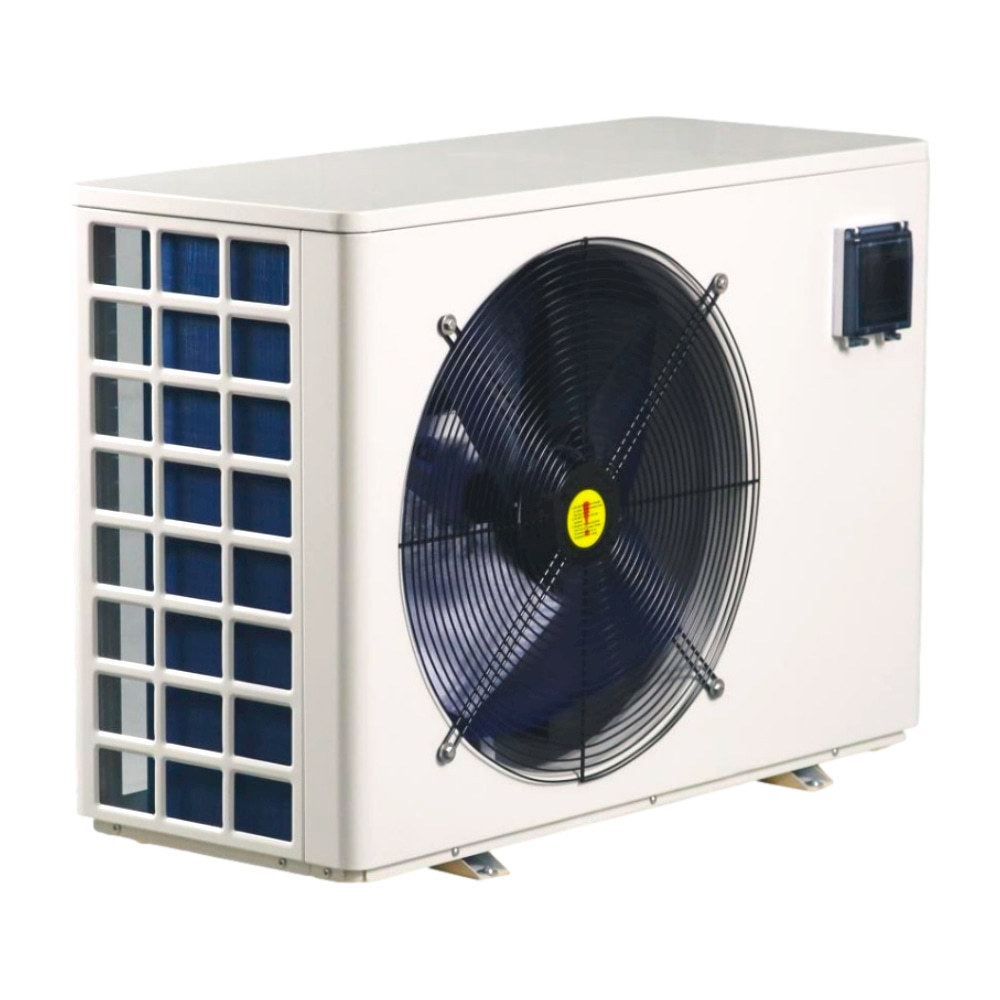
A swimming pool heat pump is one of the biggest investments you will make for your pool, and the wrong choice means years of high energy bills, noisy evenings, or premature corrosion. Whether you are a homeowner upgrading a backyard pool or a contractor specifying equipment for a hotel or community facility, this guide walks you through every decision point — from inverter compressors and titanium heat exchangers to noise ratings and warranty fine print — so you can buy with the same confidence that Suoher's OEM partners bring to their projects.
The 8-Point Pool Heat Pump Checklist
Before diving into individual features, use this quick checklist to evaluate any pool heat pump you are considering. Every point below is explained in detail in the sections that follow.
| # | Checklist Item | What to Look For |
|---|---|---|
| 1 | Compressor type | DC inverter preferred over fixed-speed for quieter, more efficient operation |
| 2 | Heat exchanger material | Pure titanium or PVC+titanium; avoid bare copper or stainless in saltwater pools |
| 3 | Noise level (dB) | Under 45 dB(A) at 1 m for residential; under 60 dB(A) at 10 m for commercial |
| 4 | COP at your climate | COP of 4.0 or higher at Air 15 °C / Water 26 °C; check low-temperature COP too |
| 5 | Operating range | Should heat down to at least 5–7 °C ambient; cooling mode is a bonus |
| 6 | Controller & connectivity | LCD controller standard; Wi-Fi for remote monitoring and scheduling |
| 7 | Certifications | CE, ErP, Keymark for EU; UL/ETL for North America; EMC and RoHS globally |
| 8 | Warranty & after-sales | Minimum 2-year整机 warranty; compressor 3–5 years; parts availability |
Print this list or screenshot it before you start comparing models — it saves hours of back-and-forth with suppliers.
Inverter vs Fixed-Speed Pool Heat Pumps
The compressor is the heart of any pool heat pump, and the choice between inverter (variable-speed) and fixed-speed (on/off) technology affects everything from your electricity bill to how much you hear the unit running at night.
A fixed-speed compressor runs at 100% output or it shuts off entirely — there is no middle ground. This on/off cycling wastes energy during start-up ramps and creates temperature swings. A DC inverter compressor, by contrast, modulates its speed continuously, ramping up only when the pool needs a quick heat boost and settling to a low-speed cruise mode once the target temperature is reached.
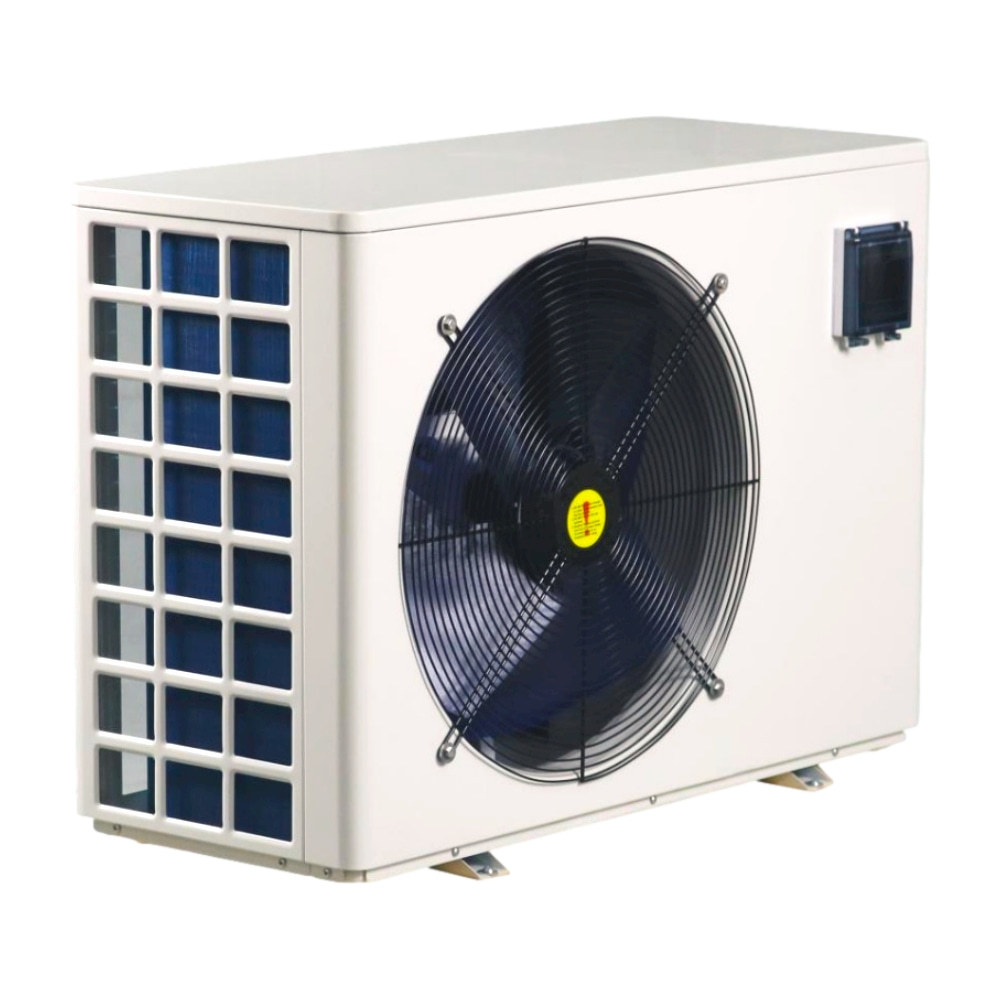
Suoher SHPH-12.5DC — DC Inverter Pool Heat Pump
- Heating capacity: 12.5 kW (suitable for pools up to 60 m³)
- DC inverter compressor with variable-speed modulation
- Built-in Wi-Fi controller for remote scheduling and monitoring
- Titanium heat exchanger with PVC shell — saltwater safe
- Compact metal cabinet: 903 × 390 × 641 mm
The SHPH-12.5DC combines stepless inverter modulation with Wi-Fi control and a titanium heat exchanger in a compact residential footprint. Suoher builds this unit for homeowners and installers who want whisper-quiet heating without sacrificing efficiency.
View Product DetailsNoise Levels
This is where inverter technology shines. A fixed-speed unit roars to 100% every cycle, then goes dead silent, then roars again — that on/off pattern is what makes pool heat pumps annoying to neighbours. An inverter unit like the Suoher SHPH-12.5DC can hold a low 35–40 dB(A) cruise speed for hours, barely noticeable from a few metres away. Once the pool reaches setpoint, the compressor slows further rather than shutting off, eliminating the start-up thump.
For context: 40 dB(A) is roughly the sound level of a quiet library. Most Suoher DC inverter pool heat pumps are rated below 45 dB(A) at 1 metre in their standard operating range, making them suitable for residential installations close to property lines.
Efficiency at Partial Load
A pool rarely needs full heating power. Once the water is warm, the demand drops to simply maintaining temperature against heat loss through the surface and walls. This is where inverter efficiency pulls ahead dramatically.
A fixed-speed 12 kW unit cycling on and off might average a COP of 4.0 across a day. The same capacity in a DC inverter unit running at 30–50% load can sustain a COP of 6.0 or higher at the same conditions, because the compressor operates in its sweet spot without the energy penalty of repeated start-up surges. Over a swimming season, that 30–50% efficiency gain translates directly into lower electricity bills.
Heat Exchanger Material Matters
The heat exchanger is where pool water meets the refrigerant circuit — and it is the component most likely to fail if the material is wrong for your water chemistry. A pool heat pump that heats beautifully for two years and then leaks refrigerant because the exchanger corroded is not a bargain, no matter how low the purchase price.
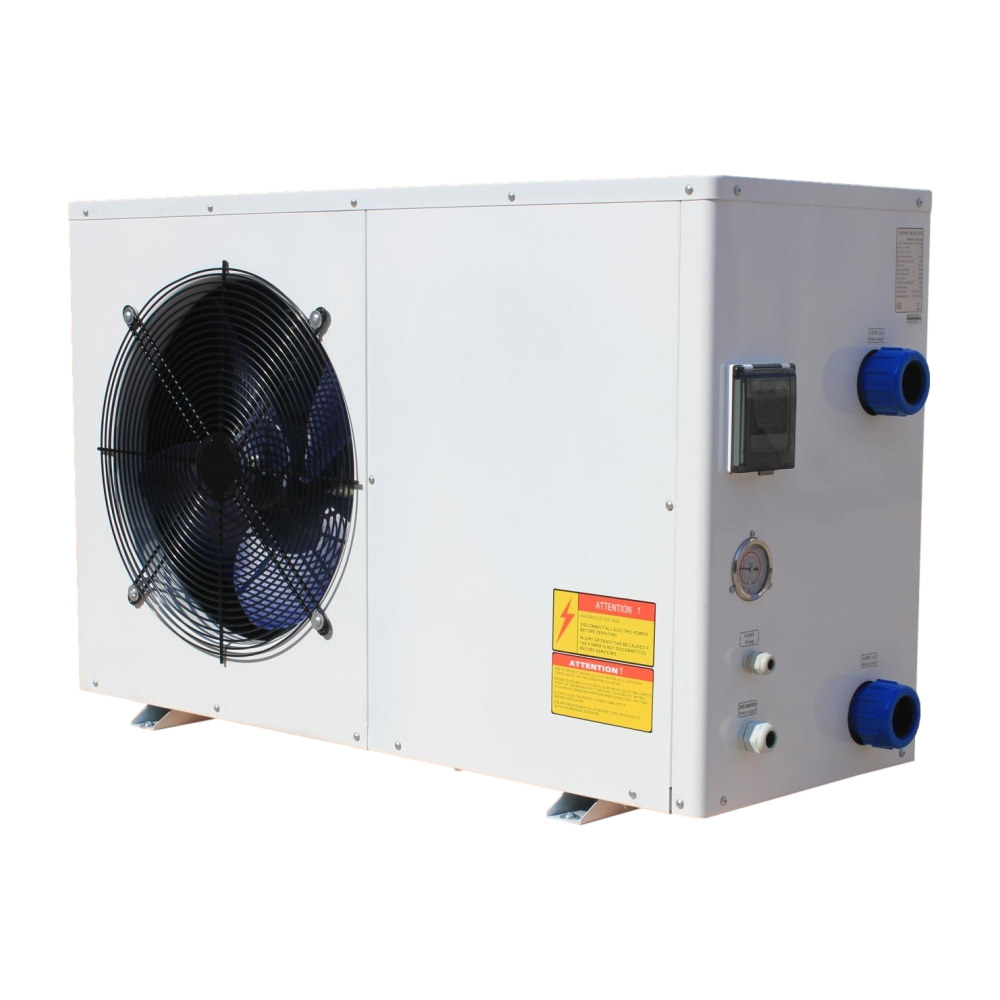
Suoher SHPH-15CH — Titanium Heat Exchanger Pool Heat Pump
- Heating capacity: 15 kW for pools up to 75 m³
- PVC + pure titanium heat exchanger — immune to salt and chlorine corrosion
- LAMDA (GREE) compressor for reliable, efficient operation
- OEM/ODM available with custom branding and specs
- Net dimensions: 1110 × 460 × 700 mm
The SHPH-15CH uses a PVC-shell titanium tube heat exchanger that handles saltwater, chlorine, and mineral-heavy fill water without degradation. Suoher offers full OEM/ODM customization, making this model a favourite among pool contractors and distributors.
View Product DetailsTitanium vs Stainless Steel vs PVC
Three common heat exchanger materials dominate the pool heat pump market, and each has a distinct suitability profile:
| Material | Saltwater Pool | Chlorine Pool | Lifespan | Verdict |
|---|---|---|---|---|
| Pure titanium | Excellent | Excellent | 10+ years | Best overall; standard on Suoher pool units |
| Stainless steel | Poor — pitting corrosion | Fair | 3–5 years | Avoid for saltwater; cheaper but risky |
| PVC shell + titanium tube | Excellent | Excellent | 10+ years | Best value; combines corrosion-proof tube with insulated shell |
Suoher's entire swimming pool heat pump line uses PVC + titanium heat exchangers as standard. This is a deliberate engineering choice: the titanium tube handles the heat transfer, while the PVC shell provides thermal insulation that reduces standby heat loss and prevents condensation on the cabinet exterior.
Corrosion in Saltwater Pools
Saltwater chlorination systems have become the default in many markets because they reduce chemical handling and feel gentler on skin. But saltwater is far more aggressive than traditional chlorine toward metals. A stainless steel heat exchanger in a saltwater pool will typically show pitting corrosion within 2–3 seasons, eventually pinholing through the tube wall and mixing pool water with refrigerant — a catastrophic failure that costs more to repair than replacing the entire unit.
Titanium is electrochemically passive in saltwater. It forms a stable oxide layer that self-repairs if scratched, making it effectively immune to chloride-induced pitting. This is the same reason titanium is used in marine heat exchangers, desalination plants, and chemical processing equipment. When you see "titanium heat exchanger" on a pool heat pump spec sheet, it is not a marketing buzzword — it is a material choice that directly determines whether the unit lasts 3 years or 10+ years.
Noise: What dB Rating to Expect
Noise is the number one complaint from pool heat pump owners, and it is also the spec most easily misunderstood. Here is how to read the numbers:
| dB(A) at 1 m | What it sounds like | Typical product |
|---|---|---|
| 32–38 | Quiet library, barely perceptible | Premium DC inverter at low speed |
| 38–45 | Quiet conversation | DC inverter at normal speed; high-end fixed-speed |
| 45–55 | Normal conversation / office | Standard fixed-speed pool heat pump |
| 55–65 | Background music or dishwasher | Large commercial units; budget models at full load |
Always check the dB(A) rating at a specified distance. A spec that says "38 dB" without noting the measurement distance is meaningless — sound drops by roughly 6 dB each time you double the distance from the source. A unit rated 45 dB(A) at 1 metre will measure about 39 dB(A) at 4 metres, which is where your neighbours are likely sitting.
Tip: If a supplier advertises only a single "super quiet" dB figure with no conditions, ask for the sound power level (LwA) or the sound pressure at 1 m and 10 m. A reputable manufacturer like Suoher provides both residential and commercial noise data on request.
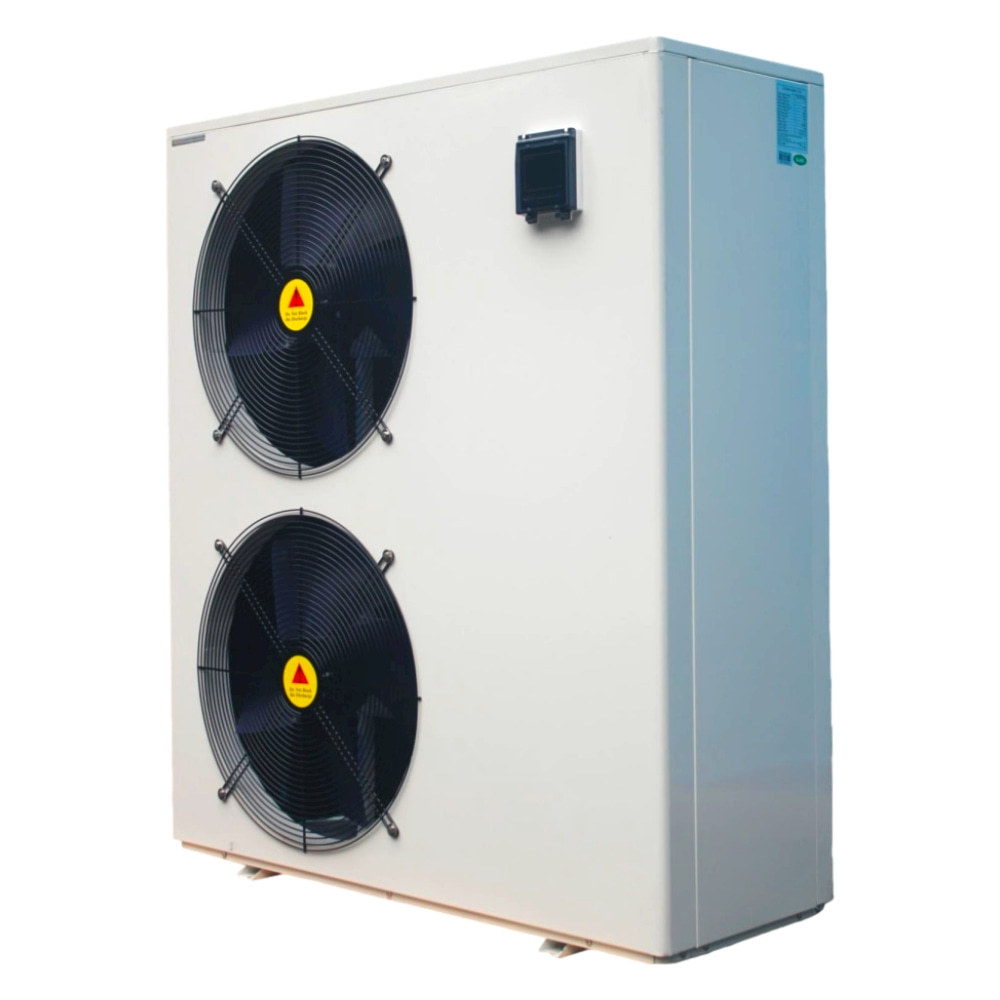
Suoher SHPH-28DC — a larger DC inverter model for pools requiring 28 kW of heating capacity. Even at this size, the inverter compressor keeps noise well below commercial limits at partial load.
COP, Temperature Range and Wi-Fi Control
Three specifications that are often lumped together but matter for different reasons:
COP (Coefficient of Performance) tells you how many units of heat you get per unit of electricity consumed. A COP of 5.0 means 5 kW of heat for every 1 kW of electricity. But COP is always tied to specific air and water temperatures — a unit rated COP 6.0 at Air 26 °C / Water 28 °C might deliver only COP 3.5 at Air 10 °C / Water 26 °C. Always compare COP at the same conditions. Suoher's DC inverter pool heat pumps typically achieve COP 5.0–6.5 at standard rating conditions (Air 26 °C / Water 26 °C) and remain above COP 3.0 even at cool ambient temperatures.
Operating temperature range determines whether your heat pump can extend the season into early spring and late autumn. A pool heat pump that shuts down at 10 °C ambient is only useful for mid-summer heating. Suoher pool heat pumps are designed to operate down to 5–7 °C, extending the swimming season by 6–8 weeks on each end in temperate climates.
Wi-Fi control has shifted from a luxury to an expectation. A Wi-Fi-enabled controller lets you set heating schedules from your phone — pre-heat the pool before you arrive at a holiday home, or drop the setpoint when the pool is not in use to save energy. Suoher's DC inverter models (SHPH-5DC through SHPH-28DC) all include built-in Wi-Fi controllers as standard, with a companion app for iOS and Android.
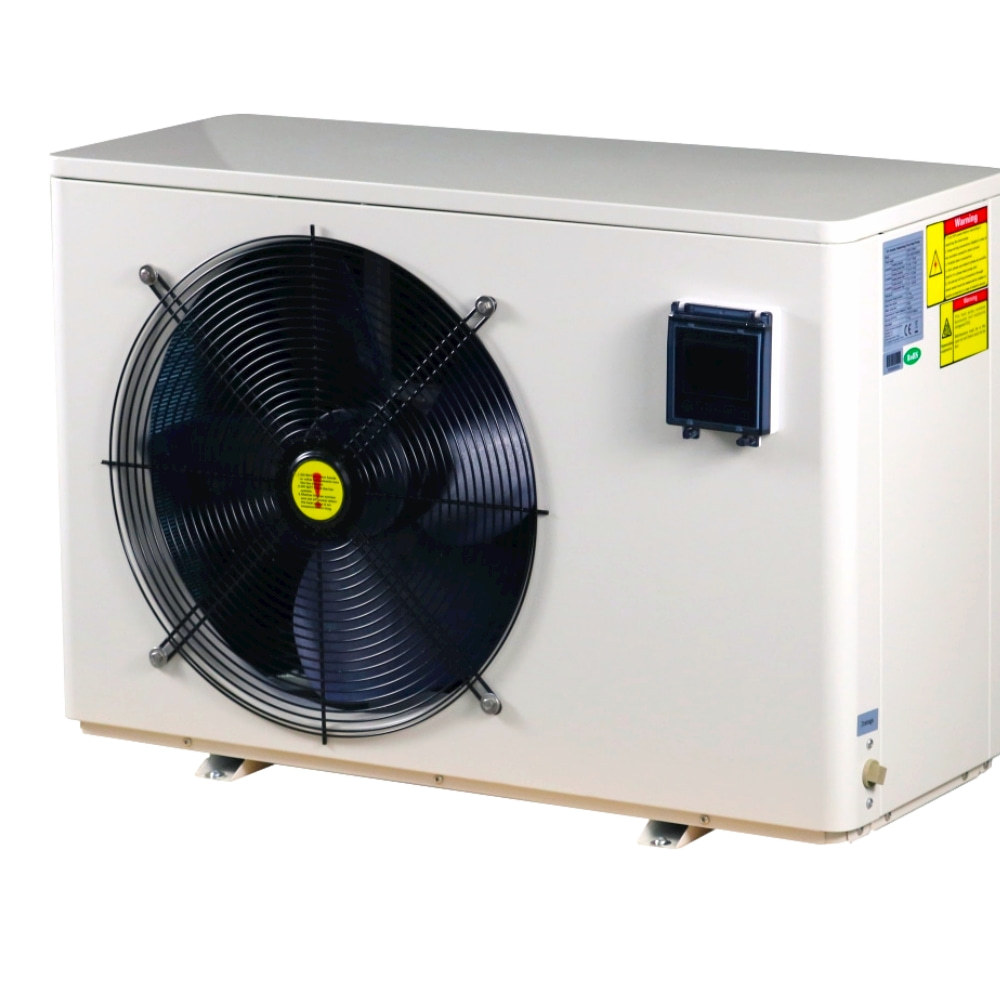
Suoher SHPH-5DC — the smallest DC inverter model in the line, designed for small residential pools up to 25 m³. Features built-in Wi-Fi, titanium heat exchanger, and R410A refrigerant.
Brand, Warranty and Certifications
Even the best-designed pool heat pump is only as reliable as the company that stands behind it. Before committing to a brand, verify two things: what certifications the unit carries, and what the warranty actually covers.
CE, ErP, UL/ETL
Certifications are not optional paperwork — they are your assurance that the unit meets minimum safety, efficiency, and electromagnetic compatibility standards in your market.
- CE marking — mandatory for sale in the EU and UK. Covers electrical safety (LVD), electromagnetic compatibility (EMC), and pressure equipment directives.
- ErP (Energy-related Products) — EU regulation requiring minimum COP and seasonal efficiency values. Pool heat pumps sold in the EU must declare their ErP rating; look for a Seasonal COP of 5.0 or higher.
- Keymark — voluntary European certification that confirms the product meets harmonised European standards, recognised across all CEN/CENELEC member countries.
- UL / ETL — safety certifications for the North American market. UL is the more widely recognised mark; ETL is an equivalent standard from Intertek.
- RoHS & EMC — restricted substances compliance and electromagnetic compatibility; required in most global markets.
Suoher pool heat pumps carry CE, EMC, RoHS, and ErP certifications as standard, with UL/ETL available on request for North American distributors.
Warranty Terms
Read the warranty document, not just the marketing headline. Key questions:
- Is the compressor covered separately from the rest of the unit? Many brands offer 2 years on the整机 but 3–5 years on the compressor — make sure both are stated explicitly.
- Does the warranty cover parts only, or parts and labour? Parts-only warranties are common in OEM/ODM exports; ask your distributor about labour coverage.
- What voids the warranty? Improper installation, unauthorised modifications, and using the unit outside its rated temperature range are standard exclusions — but some brands also exclude "non-professional installation," which means the warranty only applies if an authorised technician installs the unit.
- How long has the manufacturer been in business? A 5-year warranty is only as good as the company behind it. Suoher has been manufacturing heat pumps in Foshan, China since the company's founding, with a documented export track record to over 30 countries.
Red Flags to Avoid
If you encounter any of these warning signs during your evaluation, step back and ask more questions:
Vague COP Claims
A spec sheet that says "COP up to 10" without specifying air/water temperatures is not comparing like for like. Real-world COP at Air 15 °C will be far lower. Always demand COP at standard rating conditions.
"Stainless steel" Heat Exchanger in a Saltwater Pool
Some budget units use stainless steel exchangers to cut costs. In a saltwater pool, this is a ticking time bomb. If the spec sheet does not explicitly say "titanium," assume it is not.
No Measured dB Rating
"Ultra quiet" is not a specification. If the manufacturer cannot provide a dB(A) figure at a defined distance, they are either hiding the number or have not tested it.
Missing Certification Documents
If a supplier claims "CE certified" but cannot produce the declaration of conformity or test report, treat the claim as unverified. Reputable manufacturers provide certificate copies on request.
Warranty Shorter Than 2 Years
A pool heat pump should last 8–10 years. If the manufacturer does not trust their own product for at least 2 years of整机 coverage, that tells you everything about expected reliability.
Unbranded or Relabelled Units
If the manufacturer name on the spec sheet differs from the brand on the cabinet, or if no manufacturer is named at all, you are looking at a relabelled product with no accountable party for warranty claims.
Choose Your Pool Heat Pump with Confidence Today
You now have the framework: an 8-point checklist, a clear understanding of why inverter compressors and titanium heat exchangers matter, realistic noise and COP benchmarks, and a list of red flags that separate serious manufacturers from the rest. The next step is to match these criteria to your pool volume, climate, and budget.
Suoher manufactures a full range of swimming pool heat pumps — from the compact 5 kW SHPH-5DC for small residential pools up to the 105 kW SHPH-105CV for large commercial facilities — all with DC inverter options, PVC+titanium heat exchangers, built-in Wi-Fi control, and full OEM/ODM customization. Every unit is built in our Foshan factory with CE, ErP, and RoHS certifications as standard.
Ready to find the right pool heat pump for your project? Browse our swimming pool heat pump catalogue to compare models, or send us your pool specifications and our engineering team will recommend the right capacity and configuration for your climate and pool volume. For more on sizing calculations, see our pool heat pump sizing guide with BTU formulas and worked examples.