Swimming Pool Heat Pump Sizing: BTU Calculator, Formulas and Examples
- Share
- publisher
- Suoher Heat Pump Team
- Issue Time
- Aug 23,2026
Summary
Practical guide to swimming pool heat pump sizing: the BTU = Volume x DeltaT x 8.34 formula, pool volume calculation for rectangular and circular pools, DeltaT selection by climate, a sizing table from 5,000 to 40,000+ gallons, evaporation and wind heat-loss factors, DC inverter advantages, three worked examples, and common sizing mistakes to avoid.
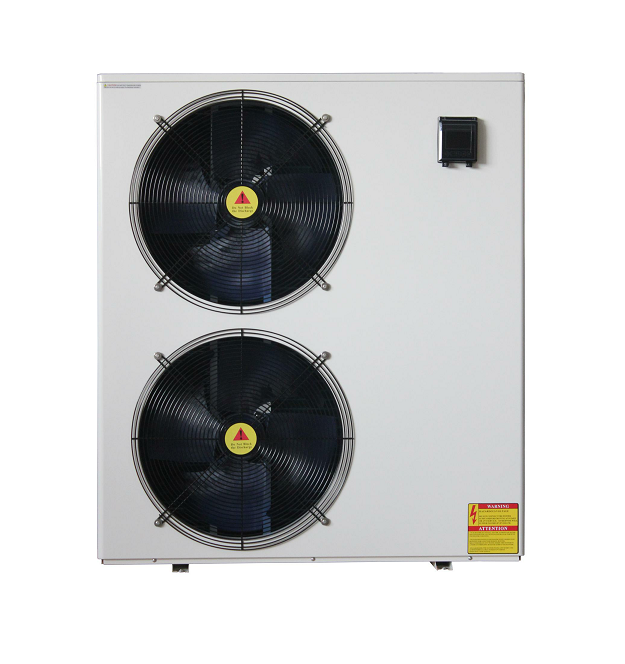
Pool owners and contractors often ask: "What size heat pump do I need for my pool?" The answer is not a single number — it depends on your pool volume, desired temperature rise, local climate, wind exposure, and whether you use a cover. Get it wrong and you will either shiver through spring or pay for capacity you never use. This guide walks through the BTU sizing formula, provides a ready-to-use sizing table, and shows three worked examples — so you can match your pool to the right unit from Suoher's pool heat pump lineup with confidence.
Why Pool Heat Pump Sizing Is Different From Space Heating
Space-heating heat pumps are sized to offset building heat loss through walls, windows, and roofs. Pool heat pumps face a completely different physics problem. A swimming pool is an open body of water exposed to ambient air, wind, and evaporation — three loss channels that a building envelope never deals with simultaneously.
Key differences include:
- Evaporation dominates. Water turning to vapor pulls roughly 2260 kJ per liter from the pool. In an uncovered pool, evaporation accounts for about 70% of total heat loss — far more than radiation or convection.
- No insulation. A pool has no R-value barrier. The water surface is in direct contact with air, so heat loss scales with surface area, not volume.
- Target temperature is lower. Pools run at 26–30°C (79–86°F), while space heating targets 20–24°C. The delta-T is smaller, but the surface area is enormous.
- COP is higher. Because pool water temperatures are low, the compressor works against a smaller temperature lift, so a pool heat pump can achieve COP values of 4.5–6.5 — notably higher than most space-heating units.
These factors mean you cannot simply convert a space-heating kW rating to a pool BTU figure. You need the pool-specific formula below.
The Core Formula: BTU = Volume × ΔT × 8.34
Every pool sizing calculation starts from one equation:
BTU/h = Pool Volume (gal) × ΔT (°F) × 8.34 lb/gal ÷ 24 h
The constant 8.34 is the weight of one US gallon of water. ΔT is the temperature gap between your target pool temperature and the coldest average air temperature during the swimming season. Dividing by 24 hours gives the hourly heat-loss rate the pump must offset.
Pool Volume Calculation (Rectangular / Circular)
Before you can apply the formula, you need accurate volume data:
- Rectangular pool: Length (ft) × Width (ft) × Average Depth (ft) × 7.48 = Volume (gal)
- Circular pool: Radius² (ft) × 3.14 × Average Depth (ft) × 7.48 = Volume (gal)
- Kidney / freeform: Measure the surface area, multiply by average depth, then by 7.48. For irregular shapes, break the pool into rectangles and circles, calculate each, and add them.
For metric users: Volume (m³) × 1000 = Volume (kg). Then BTU/h = Volume (kg) × ΔT (°C) × 4.184 kJ/kg·°C ÷ 3600 s = kW required.
Choosing ΔT (Typical 10–20°F)
ΔT is the single most impactful variable. A common mistake is using the difference between the target water temperature and the current water temperature — that only tells you the initial heat-up load, not the steady-state loss.
Instead, use the difference between your desired pool temperature and the coldest average nighttime air temperature during the months you plan to swim:
- Mild climate (Florida, Mediterranean): ΔT = 10–15°F (5.5–8°C)
- Temperate climate (central Europe, Pacific NW): ΔT = 15–20°F (8–11°C)
- Cold climate (Scandinavia, mountain regions): ΔT = 20–30°F (11–17°C)
COP Adjustment
The raw BTU/h figure assumes 100% efficiency. Real heat pumps deliver a COP (Coefficient of Performance) of 4–6, meaning the output is 4–6 times the electrical input. But the sizing formula already calculates the heat loss the pump must replace — so the BTU/h from the formula equals the required heating output, not the electrical input. Simply match the pump's rated heating output (in BTU/h or kW) to the calculated loss.
If you want faster initial heat-up (e.g., opening the season), add a 20–25% oversizing margin to the steady-state figure. This lets the pump recover temperature in 24–48 hours rather than 72+ hours.
Sizing Table by Pool Volume
The table below provides a quick reference for common residential and semi-commercial pool sizes. It assumes an uncovered pool, mild wind exposure, and a target temperature of 28°C (82°F).
| Pool Volume (gal) | Pool Volume (L) | ΔT 10°F | ΔT 15°F | ΔT 20°F | Recommended kW |
|---|---|---|---|---|---|
| 5,000 | 19,000 | 17,375 BTU/h | 26,063 BTU/h | 34,750 BTU/h | 3–6 kW |
| 10,000 | 38,000 | 34,750 BTU/h | 52,125 BTU/h | 69,500 BTU/h | 6–11 kW |
| 15,000 | 57,000 | 52,125 BTU/h | 78,188 BTU/h | 104,250 BTU/h | 10–15 kW |
| 20,000 | 76,000 | 69,500 BTU/h | 104,250 BTU/h | 139,000 BTU/h | 15–18 kW |
| 30,000 | 114,000 | 104,250 BTU/h | 156,375 BTU/h | 208,500 BTU/h | 18–26 kW |
| 40,000+ | 150,000+ | 139,000+ BTU/h | 208,500+ BTU/h | 278,000+ BTU/h | 26–42 kW |
BTU/h values are steady-state heat-loss estimates. For initial heat-up, add 20–25% margin. Commercial pools with heavy bather load or high wind exposure may require 30% additional capacity.
Climate and Heat-Loss Factors
The formula gives you a baseline. Real-world heat loss depends on three environmental factors that can shift your required capacity by 30–50%.
Evaporation Accounts for ~70% of Heat Loss
An uncovered pool loses heat fastest through evaporation, not conduction or radiation. According to the U.S. Department of Energy, a standard 14×28 ft pool can lose up to 70% of its heat through evaporation alone. Each liter of evaporated water carries away 2260 kJ of thermal energy — equivalent to running a 1 kW heater for 38 minutes.
High humidity actually helps: in tropical climates where ambient humidity exceeds 80%, evaporation slows, and a smaller heat pump may suffice. In arid climates (desert regions, inland Australia), evaporation is aggressive, and you should size up by 15–25%.
Wind Exposure
Wind accelerates evaporation by sweeping saturated air away from the pool surface. A pool in an open field with 15+ km/h prevailing wind can lose 30% more heat than a sheltered pool of identical size. If your pool is exposed to steady wind, add 10–20% to the calculated BTU/h, or install a windbreak (hedge, fence, or glass panel).
Pool Covers
A solar cover (bubble blanket) is the single most effective heat-loss reduction tool. It can cut evaporation by 95%, reducing total heat loss by 60–70%. If you use a cover consistently, you can downsize the heat pump by one capacity tier. This is why Suoher engineers always ask clients about cover usage before recommending a model — it changes the math significantly.
Inverter Pool Heat Pumps: Variable Speed Advantage
Traditional on/off pool heat pumps run at full capacity until the target temperature is reached, then shut off. This creates temperature swings and frequent compressor cycling that wastes energy. DC inverter pool heat pumps solve this by modulating compressor speed to match the actual heat load in real time.
Benefits of inverter technology for pool heating:
- 40–60% lower running cost — the compressor ramps down instead of cycling off, maintaining steady-state efficiency.
- Tighter temperature control — ±0.5°C vs. ±2°C for on/off units.
- Quieter operation at partial load — an inverter running at 30% capacity produces significantly less noise than a fixed-speed unit.
- Longer compressor life — fewer start/stop cycles reduce mechanical wear.
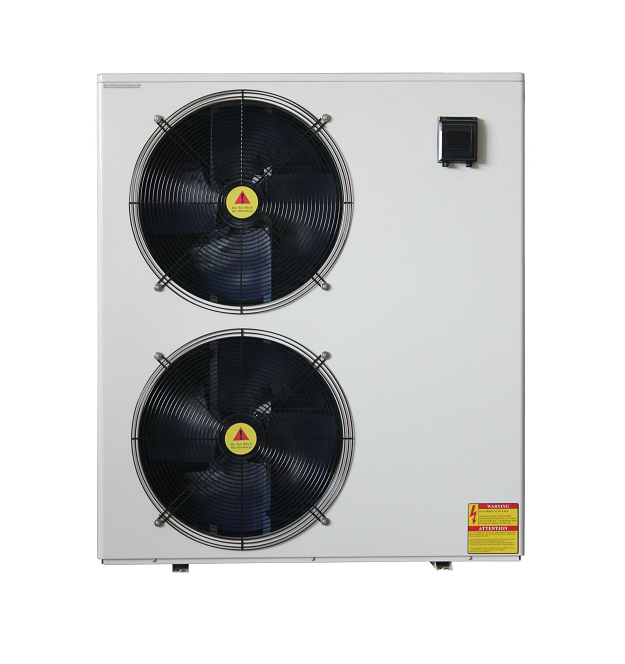
Suoher SHPH-40DC3 — 40 kW DC Inverter Pool Heat Pump
Variable-frequency compressor with titanium heat exchanger and intelligent Wi-Fi controller. Ideal for 30,000–50,000 gal commercial and hotel pools where precise temperature holding and low running cost matter.
View ProductWorked Examples for 3 Typical Pools
Let us apply the formula to three real-world scenarios that our factory engineering team encounters regularly.
Example 1: Small Backyard Pool (5,000 gal, mild climate)
Setup: 16×10 ft rectangular pool, 4 ft average depth, located in Florida. Target temperature 82°F (28°C). Coldest swimming-season nighttime average: 72°F. ΔT = 10°F.
Calculation: Volume = 16 × 10 × 4 × 7.48 = 4,787 gal. BTU/h = 4,787 × 10 × 8.34 ÷ 24 = 16,633 BTU/h. With a 20% heat-up margin: ~20,000 BTU/h = ~6 kW.
Recommendation: A compact unit like the SHPH-3MH (2.1–3 kW, COP 4.6–6, 110V) handles maintenance heating for this pool. For faster heat-up, step up to a 6 kW model.
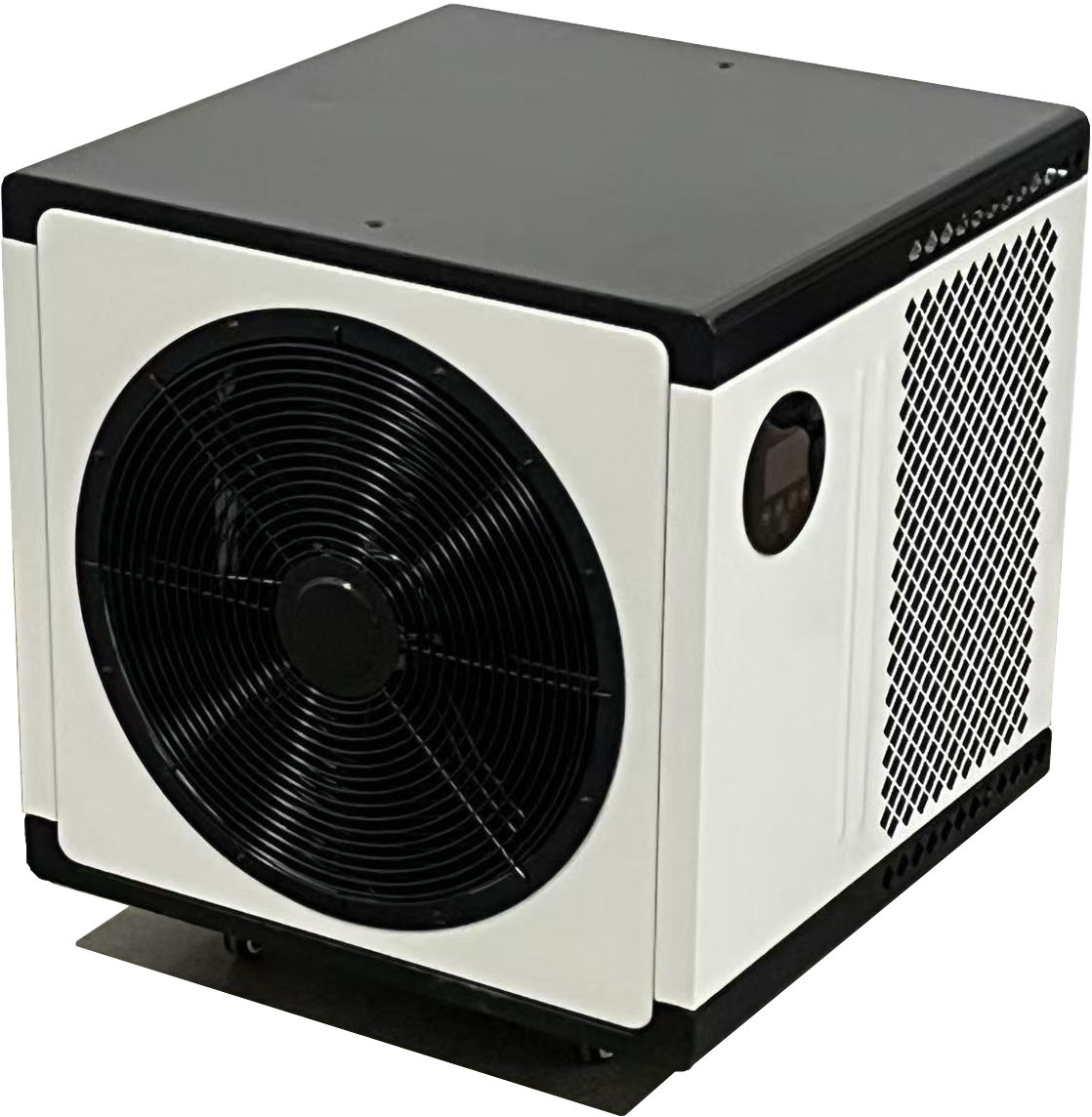
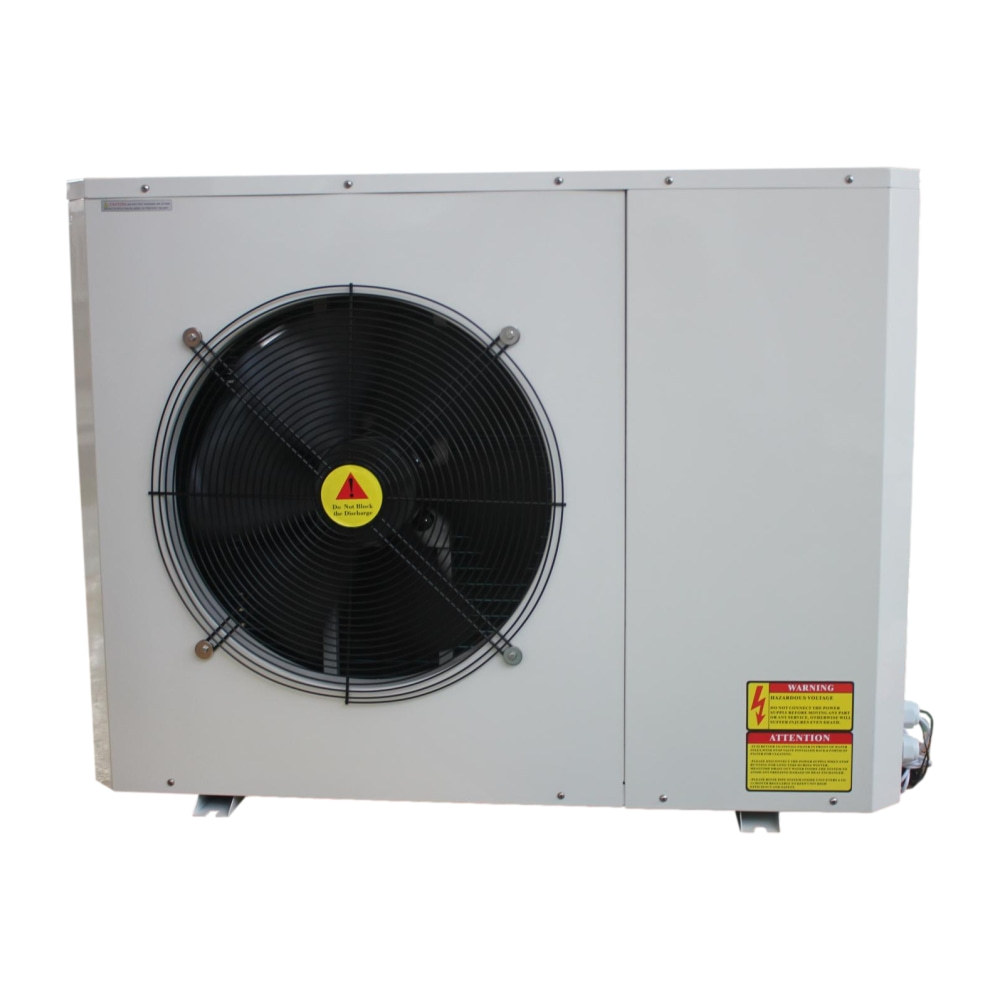
Suoher SHPH-3MH — Mini Pool Heat Pump
Compact and lightweight — perfect for above-ground pools, spas, and small residential pools up to 5,000 gal. Plug-and-play 110V operation, no electrician required for most installations.
View ProductExample 2: Mid-Size Family Pool (15,000 gal, temperate climate)
Setup: 30×15 ft oval pool, 5 ft average depth, located in central France. Target 28°C. Coldest spring nighttime average: 13°C (55°F). ΔT = 28°C − 13°C = 15°C = 27°F.
Calculation: Volume = 30 × 15 × 5 × 7.48 = 16,830 gal. BTU/h = 16,830 × 27 × 8.34 ÷ 24 = 157,847 BTU/h. That is roughly 46 kW of heating output at steady state — but with a pool cover reducing losses by 60%, effective load drops to ~63,000 BTU/h = ~18 kW.
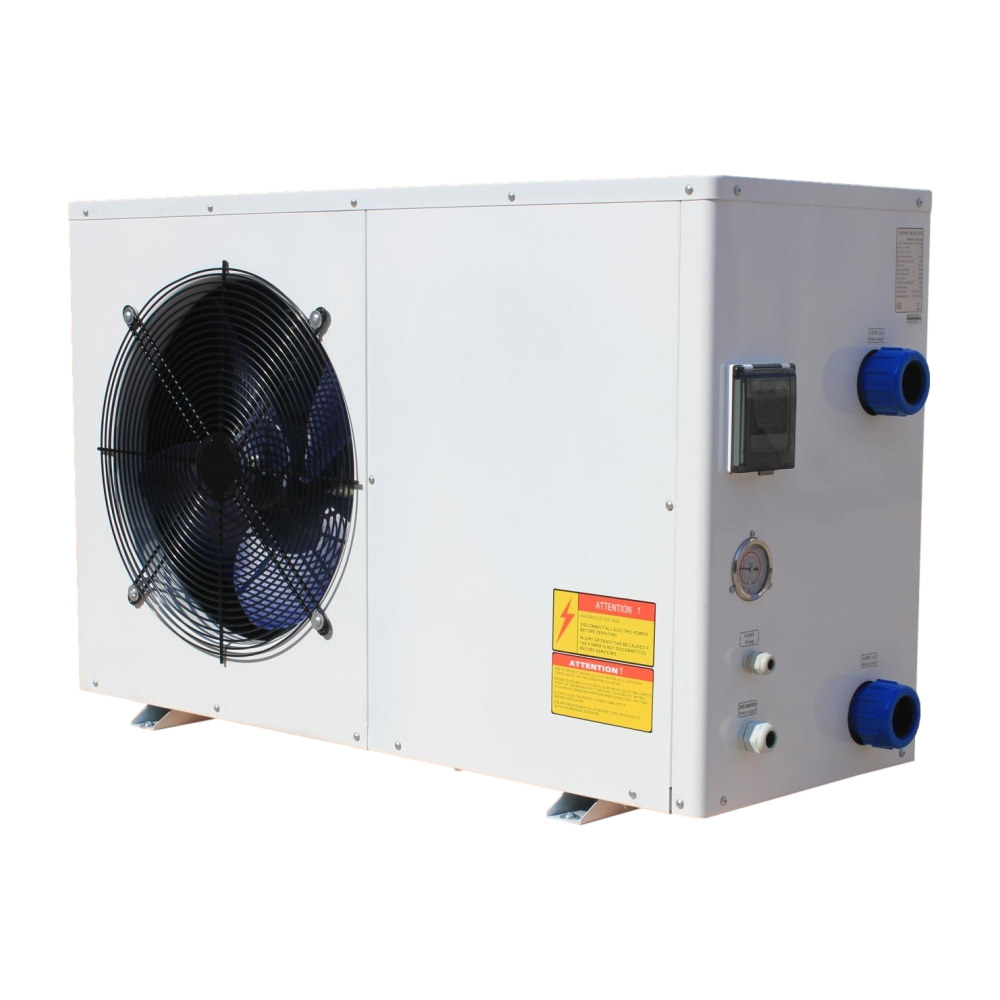
Recommendation: An 11–15 kW pool heat pump from the SHPH-11CH/13CH range (COP 4.61–5.88, titanium heat exchanger) paired with a solar cover will maintain temperature comfortably.
Example 3: Hotel Pool (40,000 gal, commercial)
Setup: 20×10 m commercial pool, 1.5 m average depth, located in a coastal resort in Spain. Target 28°C. Coldest month average: 12°C. ΔT = 16°C = 29°F. Pool is uncovered with moderate wind exposure.
Calculation: Volume = 20 × 10 × 1.5 × 1000 = 300,000 L = 79,250 gal. BTU/h = 79,250 × 29 × 8.34 ÷ 24 = 799,342 BTU/h = ~234 kW. This pool needs multiple units or a single large commercial heat pump. The SHPH-40DC3 (28–40 kW) or a cascade of 2× SHPH-40DC3 plus a backup electric heater would be the recommended configuration.
Common Sizing Mistakes
- Mistake 1: Sizing for heat-up speed only. A 40 kW pump will heat a 10,000 gal pool in 4 hours — but it will short-cycle every 20 minutes once at temperature, wasting energy. Size for steady-state loss, then add 20% for recovery.
- Mistake 2: Ignoring the cover. An uncovered pool needs 2–3× the heating capacity of a covered one. If you plan to use a cover, size accordingly — you will save on both purchase cost and running cost.
- Mistake 3: Using nameplate kW as heating output. The electrical input kW is not the heating output. A 5 kW input heat pump with COP 5 delivers 25 kW of heat. Always check the rated heating capacity, not the power draw.
- Mistake 4: Forgetting flow rate. The pump's rated water flow must match or exceed your filtration circuit flow. Undersized flow causes the heat pump to trip on high-pressure protection. Our titanium heat exchangers are designed for standard pool pump flows, but verify the m³/h rating against your existing circulation pump.
- Mistake 5: Ignoring refrigerant for commercial compliance. In the EU, F-Gas regulations are tightening. R32 is the current standard for new pool heat pumps. If you are specifying equipment for a public or hotel pool, choose R32 models to ensure regulatory compliance and future serviceability.
Dial In Your Pool BTU Budget: Request a Suoher Pool Heater Match
If you have your pool dimensions and target temperature ready, the Suoher team can run the sizing calculation for you and recommend the exact model — including flow-rate matching, cover-adjusted sizing, and multi-unit cascade design for commercial pools. We manufacture pool heat pumps from 3 kW mini units up to 68 kW commercial DC inverter systems, all with titanium heat exchangers and R32 refrigerant.
Send us your pool dimensions, location, and whether you use a cover. We will respond with a sizing recommendation, estimated running cost, and a product specification sheet within one business day.
- View SHPH-3MH Mini Pool Heat Pump (3 kW)
- View SHPH-11CH / 13CH Pool Heat Pumps (11–13 kW)
- View SHPH-40DC3 DC Inverter Pool Heat Pump (40 kW)
- Request a Free Pool Sizing Consultation
Want to read more pool heating guidance? See our existing guides on how to choose a suitable pool heat pump and why pool heat pumps need titanium heat exchangers.