Inverter vs Fixed-Speed Heat Pump Compressors: A Technical Comparison
- Share
- publisher
- Suoher Heat Pump Team
- Issue Time
- Aug 31,2026
Summary
Fixed-speed heat pump compressors run at full output and cycle on/off; DC inverter compressors modulate from roughly 10% to 100% of rated capacity. This technical comparison covers how each architecture works, head-to-head differences in seasonal efficiency, temperature stability, noise, lifespan and cost, why inverter drive matters in cold climates, common repair-cost and compatibility myths, and guidance on when to choose which - backed by factory test-bench data.
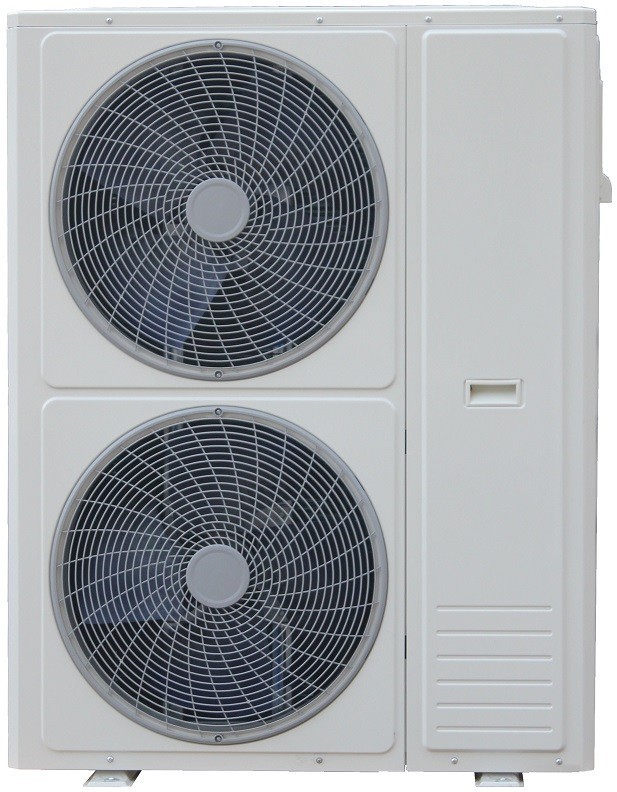
The compressor inside an air-to-water heat pump draws more than 90% of the unit's electricity — so the way it is driven decides your energy bill, your comfort and even how long the machine lives. Two architectures dominate the market: the classic fixed-speed compressor that switches on and off, and the DC inverter compressor that continuously adjusts its speed to match the heating load. This technical comparison explains how each one works, puts them head-to-head across efficiency, comfort, noise, lifespan and cost, and uses factory test-bench data from Suoher's DC inverter range to show what the difference looks like in real numbers.
The Compressor: Heart of the Heat Pump
Everything else in a heat pump — the evaporator, condenser, expansion valve, fan and controller — exists to serve the compressor. It is the component that raises the pressure and temperature of the refrigerant so that low-grade heat collected from outdoor air can be released into your heating circuit. Because it consumes the overwhelming majority of the unit's electrical input, small differences in how the compressor runs translate into large differences in seasonal energy use.
Two control philosophies define the market. A fixed-speed (single-speed) compressor runs at one speed whenever it is on, and the thermostat simply switches it on and off. A DC inverter (variable-speed) compressor receives a modulated power signal from an inverter driver board, allowing it to run at almost any speed between its minimum and maximum. That single design choice cascades into every performance metric that buyers care about.
How Fixed-Speed Compressors Work
A fixed-speed system is binary: the compressor is either at 100% output or off. Control is handled by a thermostat with a switching differential — typically 1 to 2 °C. When the measured temperature falls below the lower threshold, the compressor starts at full power; when it overshoots the upper threshold, it stops.
On/Off Cycling
Because a fixed-speed unit has no intermediate output levels, its capacity almost never matches the actual heat demand of the building. On a mild spring day a 12 kW machine may only need to deliver 3 kW — so it runs for a few minutes, satisfies the thermostat, shuts down, and repeats an hour later. This sawtooth pattern is called cycling, and each cycle carries penalties: the refrigerant circuit takes time to reach steady-state pressure ratios each start, heat exchangers work outside their design point during pull-up, and room temperature oscillates by 1 to 2 °C instead of holding steady.
Startup Energy Spikes
Every start of a fixed-speed compressor is an electrical event. The motor draws locked-rotor current of roughly 5 to 7 times its rated running current for the first fraction of a second until the rotor spins up. On a weak single-phase supply this can dim lights and stress wiring. Compressor manufacturers' own endurance data consistently identify start-stop events — not running hours — as the dominant wear mechanism, which is why a unit that cycles 50 to 200 times a day ages faster than the nameplate hours suggest.
How DC Inverter Compressors Work
A DC inverter heat pump replaces the on/off relay with a variable frequency drive, letting the compressor behave like a dimmer rather than a light switch.
Variable Frequency Drive
The inverter driver board first rectifies the mains AC supply to direct current, then uses power electronics (an intelligent power module switching at several kHz) to synthesize a three-phase AC output whose frequency and voltage can vary continuously. This output drives a brushless DC (BLDC) motor built into the compressor. Because motor speed scales with frequency, the controller can command any rotor speed between the mechanical minimum and maximum. A control loop — usually a PID algorithm comparing leaving-water temperature with the setpoint — updates the command every few seconds, so the compressor continuously chases the building's real heat demand.
10-100% Capacity Modulation
The practical result is a modulation range of roughly 10% to 100% of rated capacity. In shoulder seasons the unit may run at minimum speed for long stretches, sipping power while holding the water temperature within a fraction of a degree. Instead of starting and stopping, it starts once and then speeds up or slows down. This is also why inverter units score so well under EN 14825 seasonal testing: the standard's part-load bins (100%, 74%, 55%, 35% of load) reward exactly the low-output conditions where a modulating compressor is most efficient — while a fixed-speed unit must cycle through the same bins and absorb the losses each time.
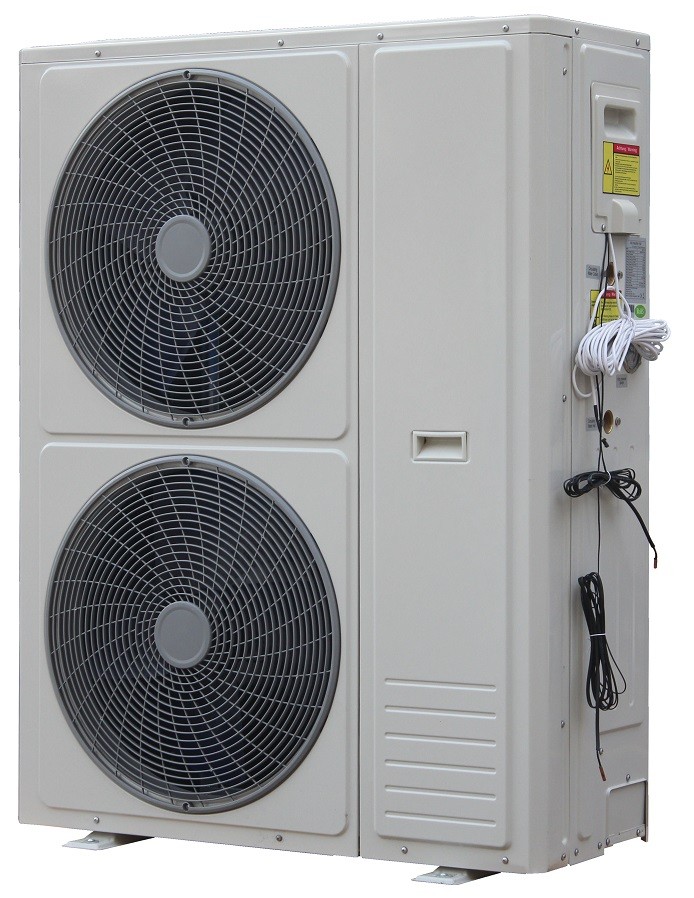
SHAW-15DM3/K DC inverter unit — the driver board modulates compressor speed between roughly 10% and 100% of rated capacity.
Head-to-Head Comparison
The table below condenses the engineering differences into the metrics that show up in a buyer's spreadsheet.
| Metric | Fixed-Speed Compressor | DC Inverter Compressor |
|---|---|---|
| Capacity control | On/off at 100% only | Modulating, ~10-100% |
| Seasonal efficiency (SCOP) | Baseline; cycling losses apply | Typically 15-30% higher in same climate |
| Water temperature stability | ±1-2 °C sawtooth | Within ±0.5 °C |
| Part-load noise | Always full-speed rotor noise | Runs slower and quieter at low load |
| Compressor starts per day | 50-200 (weather dependent) | Usually fewer than 10 |
| Startup current draw | 5-7× rated current each start | Soft ramp, close to running current |
| Expected service life | 10-12 years typical duty | 15+ years typical duty |
| Upfront cost | Lowest purchase price | 10-30% higher, repaid over lifetime |
Efficiency
Cycling losses are the hidden tax on fixed-speed units. Field and laboratory research on thermostatically controlled heat pumps attributes on the order of 10-30% seasonal energy loss to cycling — start-up transients, pull-down periods running off-design, and standby between cycles. Inverter units largely eliminate this tax because the compressor settles into a steady operating point for hours at a time. As a reference point from Suoher's test bench, the SHAW-9DM1/K datasheet shows a COP range of 1.5-4.49 across its operating envelope — a reminder that efficiency is a curve, not a point, and a modulating machine spends far more of its life in the favorable region of that curve.
Comfort and Temperature Stability
Radiators and underfloor circuits deliver noticeably more even heat when the water temperature is held constant instead of swinging with compressor cycles. Inverter control keeps leaving-water temperature within about half a degree, which translates into stable room temperatures without the warm-cold oscillation occupants feel with a cycling unit.
Noise
Compressor and fan noise scale with speed. At 30% load an inverter unit's rotor turns slowly enough that sound pressure drops well below its rated figure — the SHAW-15DM3/K is rated 58 dB(A) at full output but runs far quieter through most of a real heating season. A fixed-speed unit produces its full noise signature every time it runs, day or night.
Lifespan
Because start events dominate compressor wear, the start count is a direct proxy for longevity. Cutting from 100+ starts per day to a handful removes the repeated inrush shocks, lubrication interruptions and thermal cycling that crack windings and flatten bearings. Well-designed inverter systems commonly target 15 or more years of service against 10-12 for heavily cycled fixed-speed equivalents.
Cost
Fixed-speed wins on purchase price — typically 10-30% cheaper for the same nominal capacity, which is why it survives in cost-sensitive markets and simple applications. Inverter wins on total cost of ownership wherever heating hours, electricity prices or comfort expectations are meaningful, usually repaying the premium within a few seasons.
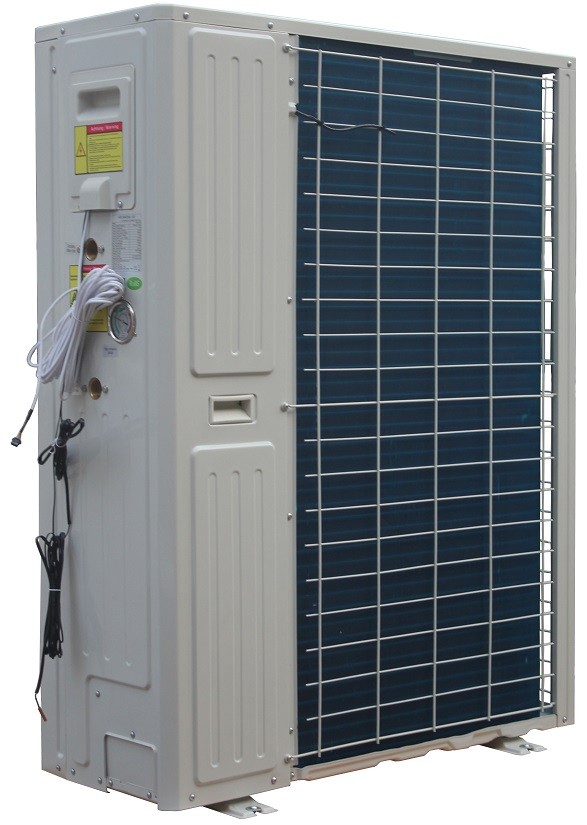
Suoher SHAW-15DM3/K — 15 kW DC Inverter Heat Pump
Economical DC inverter unit for whole-house heating and hot water. GMCC variable-speed compressor, smart control, 58 dB(A) rated noise, OEM/ODM customizable from the factory.
- Heating capacity8.9-15.2 kW
- COP range4.43-1.62
- Power supply380V / 50Hz
- Max. water temp.60 °C
Why Inverter Matters in Cold Climates
Cold weather is where the two architectures diverge hardest. As outdoor temperature falls, every heat pump loses capacity — but the two systems respond differently. A fixed-speed unit has only one gear: when its reduced full-speed output can no longer hold the setpoint, it simply runs continuously and slowly falls behind. An inverter unit can push its compressor toward the top of its modulation range to recover part of the lost capacity, then settle back as conditions improve.
Defrost behavior diverges too. A cycling unit must recover from each frost-clearing event with a cold start, while a modulating unit can coordinate the defrost cycle with compressor speed and hot-gas bypass, returning to stable heating faster. Combine inverter drive with EVI (enhanced vapor injection) technology and the compressor can hold useful output at outdoor temperatures where fixed-speed units have already switched to backup heaters. For a deeper look at the refrigerant-side half of that equation, see our EVI technology explainer.
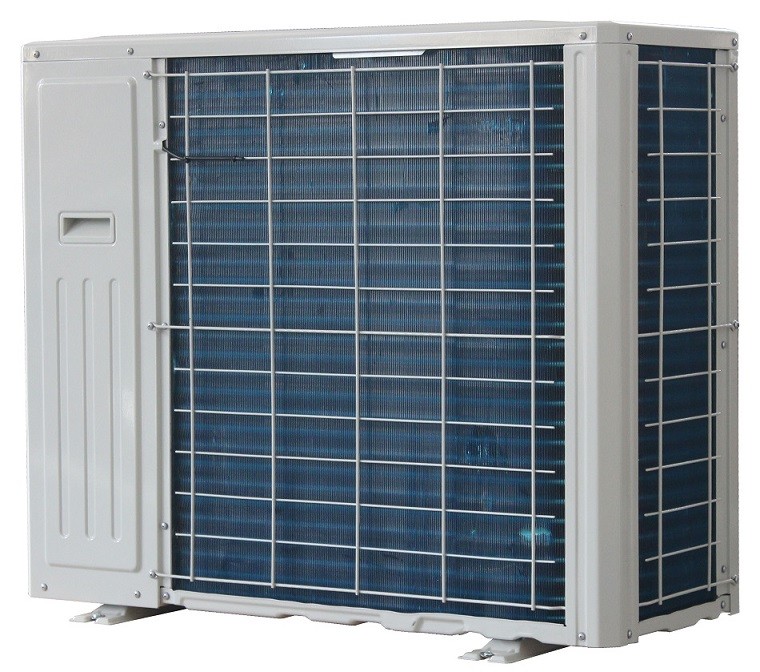
Compact DC inverter units like the SHAW-9DM1/K hold a stable leaving-water temperature even as outdoor conditions swing.
Myths About Inverter Compressors
Two misconceptions still discourage buyers who would otherwise benefit from inverter technology.
The Repair Cost Myth
"Inverter boards fail and cost a fortune to replace." In practice, the power electronics are the serviceable part — a driver board can be swapped in under an hour at a small fraction of the cost of a compressor replacement, which is the equivalent failure mode that ends a fixed-speed system's life. Modern boards are conformal-coated against moisture, self-protect with fault codes, and are diagnosable via the controller, so repairs are targeted rather than exploratory.
Compatibility Concerns
Some buyers worry that inverter units are fussy about power quality or emitters. Neither holds up. EMC compliance under EN 61000-3-2/-3-12 governs harmonics just as it does any other appliance, and wide voltage-tolerance inputs handle rural supply variation. On the hydraulic side, inverter heat pumps drive underfloor circuits, low-temperature radiators and domestic hot water tanks identically to fixed-speed models — and single-phase options such as the 220V SHAW-9DM1/K retrofit into homes without a three-phase supply, where its soft startup avoids the light-flickering inrush of a fixed-speed machine.
Buyer Guidance: When to Choose Which
Neither architecture is universally superior — the right answer follows the application.
Fixed-speed still makes sense for warm climates with short mild seasons, seasonal properties used a few weeks a year, simple pool or spa heating where temperature precision is unimportant, and projects where minimum purchase price is the binding constraint. Its simplicity is also a service advantage in markets with limited technician training.
Choose DC inverter for any primary residence in a mixed or cold climate, radiator retrofits needing stable water temperatures, noise-sensitive sites, buildings on single-phase supply, and anywhere electricity prices make seasonal efficiency the dominant lifetime cost. EU buyers take note: the part-load-weighted SCOP metric structurally favors inverter units — see our efficiency ratings guide.
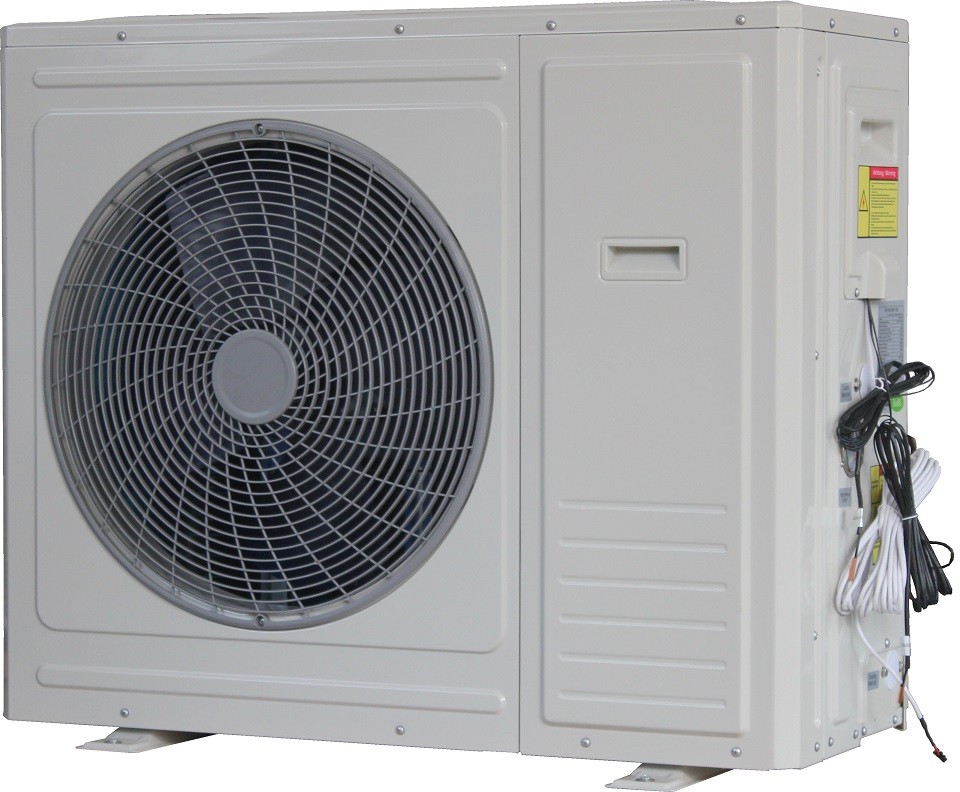
Suoher SHAW-9DM1/K — Economical DC Inverter Heat Pump
K-series DC inverter unit built around a GMCC variable-speed compressor. Single-phase 220V supply, competitive factory-direct pricing — an entry point into inverter efficiency for smaller homes.
- Heating capacity5.1-8.9 kW
- COP range1.5-4.49
- Power supply220V / 50Hz
- CompressorGMCC DC inverter
Decide With Data, Not Brochures: Request Suoher's Inverter Test Report
The verdict is straightforward: fixed-speed compressors offer the lowest purchase price and proven simplicity, while DC inverter compressors win on seasonal efficiency, comfort, noise, startup behavior and expected life. If a heat pump will heat a primary home in a real climate with real electricity prices, the inverter premium is usually the best money in the project.
Marketing claims are cheap; test data is not. Suoher backs its DC inverter range with factory test-bench measurements — capacity and COP across the modulation envelope, startup current traces and noise spectra — so you can verify every figure in this comparison against your own conditions. Browse the heat pump catalog or send an inquiry with your target climate and capacity range, and the engineering team will return the matching test report within one business day.
Stop choosing between compressor types based on sales talk. Get the bench data — capacity curves, COP envelopes and start-current traces — and make the call on evidence.
Request the Inverter Test Report