Aquaculture Temperature Control: Heat Pumps for Fish Farms and Shrimp Ponds
- Share
- publisher
- Suoher Heat Pump Team
- Issue Time
- Sep 10,2026
Summary
Heat pumps for aquaculture: titanium heat exchanger technology for fish farms and shrimp ponds. Covers water temperature biology, air source vs water source options, COP 3.5-5.0, ±0.5°C control precision, RAS integration, 60-70% energy savings vs electric heating, a tilapia farm case study with 89% mortality reduction, and a full specification checklist.
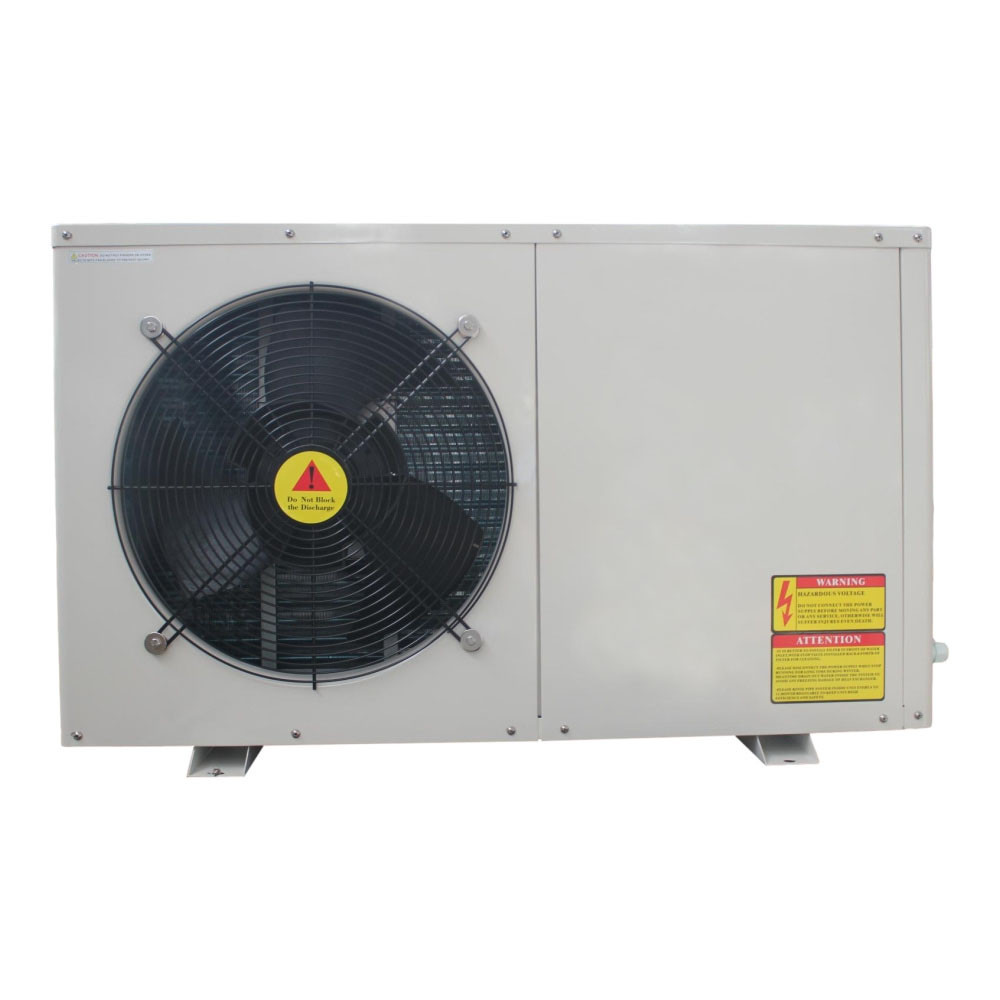
Water temperature is the single most critical environmental variable in aquaculture. Every fish species, shrimp post-larvae, and sea cucumber has a narrow thermal window where feeding, growth, and immune function are optimal. Outside that window — even by a few degrees — mortality climbs, feed conversion ratios deteriorate, and disease pressure rises. For decades, aquaculture operators have relied on electric immersion heaters, diesel boilers, and coal-fired furnaces to warm pond and tank water during cold months. These methods are energy-hungry, imprecise, and increasingly expensive as electricity prices rise. Suoher's aquaculture heat pump systems — built on the same titanium heat exchanger technology proven in thousands of swimming pool installations worldwide — deliver 60–70% energy savings while holding water temperature within ±0.5°C of setpoint. This guide explains the engineering, the economics, and a real tilapia farm project where winter mortality dropped from 40% to under 5%.
Why Water Temperature Decides Survival Rates
In aquaculture, water temperature governs three fundamental biological processes: metabolic rate, oxygen solubility, and pathogen virulence. A 2°C drop below the optimal range can reduce a tilapia's metabolic efficiency by 15–20%, meaning it eats the same amount of feed but gains less weight. A 5°C drop triggers immunosuppression, opening the door to bacterial infections like Streptococcus and Aeromonas. For shrimp (Litopenaeus vannamei), water below 25°C slows moulting cycles and increases susceptibility to white spot syndrome virus (WSSV), which can wipe out an entire pond in 72 hours.
The economic consequences are direct. A 1,000 m² tilapia pond with 10,000 fish at 500g average weight has a standing biomass worth approximately $15,000–20,000. A 40% winter mortality event — not uncommon in unheated ponds in subtropical regions — destroys $6,000–8,000 of stock in a single season. The cost of prevention (a heat pump system) is a fraction of that loss.
When ±1°C Matters
Thermal precision in aquaculture is not a luxury — it is a production requirement. Fish are poikilothermic (cold-blooded); their body temperature tracks water temperature within minutes. A temperature swing of ±3°C over 24 hours forces the fish's metabolism to constantly readjust, burning energy that should go toward growth. In recirculating aquaculture systems (RAS), the industry standard for temperature stability is ±0.5°C. Research from the Food and Agriculture Organization (FAO) and national aquaculture institutes shows that tight temperature control improves feed conversion ratios (FCR) by 10–15% compared to uncontrolled or loosely controlled systems.
For shrimp hatcheries, the stakes are higher. Post-larvae (PL) stages require water at 28–30°C with no more than ±1°C variation during the first 14 days. A sudden drop to 26°C during a cold front can trigger stress moulting, which reduces survival rates from 90%+ to 60% or lower. The broodstock holding tanks are even more sensitive — a 1°C deviation from optimal temperature can delay ovarian maturation by 7–10 days, pushing back the entire production cycle.
Winter Survival: From 50% to 95%+
In subtropical and warm-temperate aquaculture regions — including southern China, Vietnam, Thailand, and parts of Latin America — winter water temperatures in unheated ponds regularly fall to 15–18°C, well below the 25–30°C optimum for tropical species like tilapia and pacu. During the January 2024 cold wave in southern China, unheated tilapia ponds in Guangdong experienced water temperatures of 12°C for 5 consecutive days. Mortality rates reached 50–80% across thousands of hectares. Farms that had installed heat pump systems maintained water at 24–26°C and reported mortality under 5%.
The mathematics of heating is straightforward. A 500 m² earthen pond with 1.2 m average depth holds approximately 600 m³ of water. To raise that volume by 8°C (from 18°C to 26°C) requires:
Q = m × c × ΔT = 600,000 kg × 4.18 kJ/kg·°C × 8°C = 20,064,000 kJ ≈ 5,573 kWh of thermal energy
With an electric immersion heater (COP = 1.0), that costs 5,573 kWh of electricity. With a heat pump operating at COP 4.0, the electricity required is 5,573 ÷ 4.0 = 1,393 kWh — a 75% reduction. And maintaining the temperature against ongoing heat loss through the pond surface, walls, and evaporation requires continuous heat input, where the COP advantage compounds every hour of every day throughout the heating season.
Heat Pump Options for Aquaculture
Three heat pump configurations are used in commercial aquaculture, each with distinct advantages depending on the site layout, water source, and salinity. The core principle is identical: a refrigerant compressor absorbs heat from a source (air, water, or ground) and releases it into the culture water through a heat exchanger. The heat exchanger material is the make-or-break component — and titanium is non-negotiable for saltwater systems.
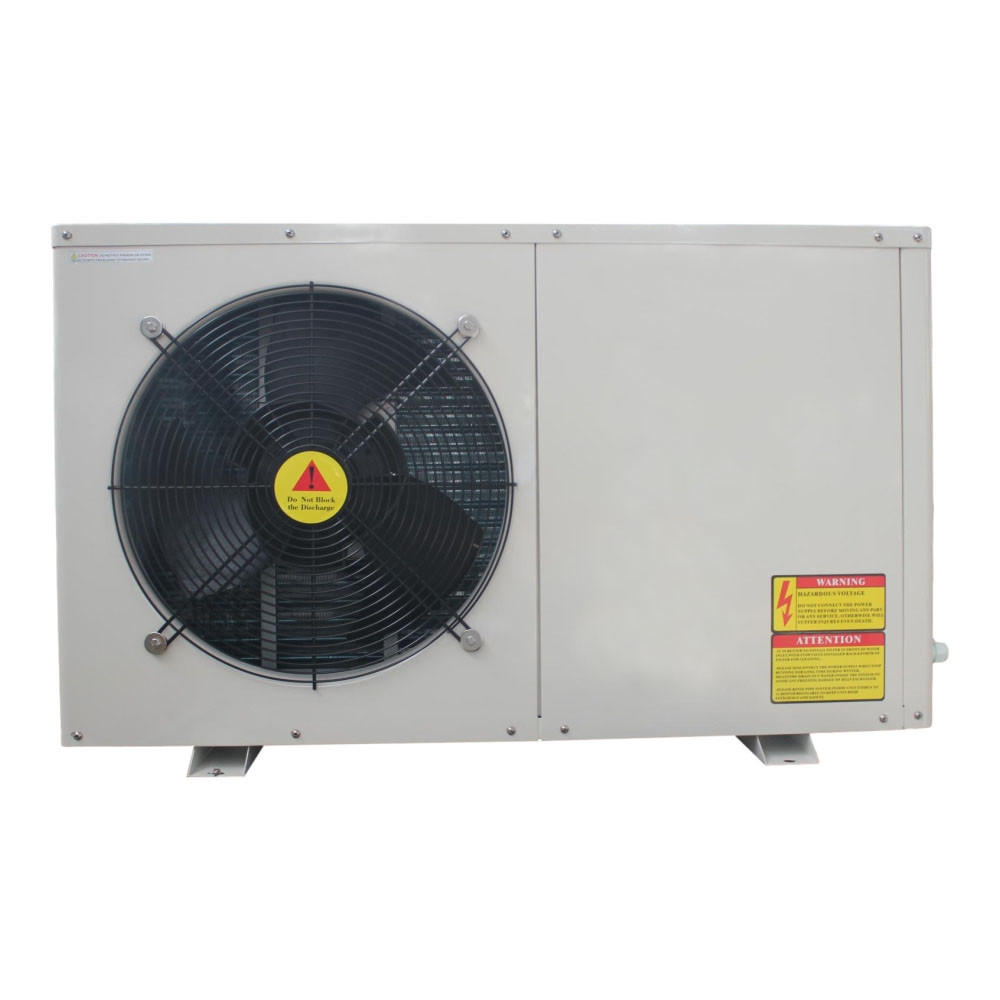
The Suoher SHPH-11CH/13CH — a titanium heat exchanger pool heat pump — shares the same PVC+titanium condenser technology that Suoher deploys in aquaculture installations. The titanium tube-in-shell design resists chloride corrosion from seawater and brackish water indefinitely.
Air Source with Titanium Heat Exchanger
Air source heat pumps (ASHP) are the most common choice for aquaculture because they require no ground loop, no well permit, and minimal civil works. The unit sits beside the pond or tank, draws heat from ambient air, and circulates culture water through a titanium heat exchanger. The Suoher pool heat pump line — including models like the SHPH-11CH/13CH and SHPH-40DC3 — uses this configuration and has been deployed in fish farms and shrimp hatcheries across Southeast Asia.
The key specification to verify is the condenser material. Standard copper or stainless steel heat exchangers will corrode within months in saltwater or brackish water. PVC+titanium is the industry standard: the PVC shell provides structural integrity and chemical resistance, while the titanium internal tubes carry the refrigerant-to-water heat exchange. Titanium has a corrosion resistance rating of >50 years in seawater, compared to 1–3 years for 316L stainless steel under the same conditions.
Water Source (Lake, River, Well)
Water source heat pumps (WSHP) extract heat from a natural water body — a lake, river, or groundwater well — and are inherently more efficient than air source units because the source temperature is stable year-round (8–18°C depending on depth and location). A water source unit can achieve COPs of 4.5–6.0 in aquaculture applications, compared to 3.5–4.5 for air source units in winter conditions. However, WSHP systems require a secondary water intake and filtration system to prevent sediment, algae, and biofouling in the primary heat exchanger, which adds capital cost and maintenance complexity. They are best suited for farms with existing water abstraction infrastructure or sites adjacent to a stable water body.
Saltwater Corruption Requirements
For marine aquaculture — sea bass, sea bream, yellowtail, and marine shrimp — the culture water has a chloride concentration of 18,000–35,000 mg/L. This is aggressively corrosive to copper, brass, and most stainless steel grades. The heat exchanger must be titanium or a titanium alloy (Grade 2 commercially pure titanium is the standard). Suoher's titanium heat exchanger design uses a tube-in-shell configuration where the culture water flows through the titanium tube bundle and the refrigerant circulates in the shell side. This isolates the water contact surface entirely in titanium, with no exposed copper or steel components.
Additional saltwater considerations include:
- Pump selection: Culture water pumps must use titanium, plastics (PP, PVC, PVDF), or rubber-lined impellers — never cast iron or aluminium.
- Pipework: PVC-U, HDPE, or FRP (fibreglass reinforced plastic) — never galvanised steel or copper.
- Control sensors: Titanium or plastic-bodied temperature probes; stainless steel probes will pit and fail in 6–12 months.
- Earthing: Stray current corrosion is accelerated in saltwater; all electrical bonding must use titanium or graphite earthing points.
System Design: COP, Precision, and Recirculation
Designing a heat pump system for an aquaculture facility requires three engineering decisions that determine operating cost, capital cost, and biological outcome: target COP, temperature control precision, and integration with the recirculating system.
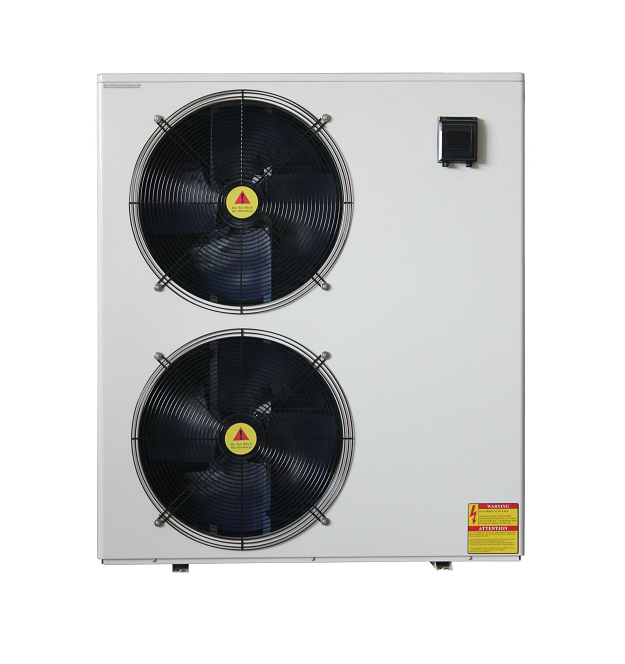
The Suoher SHPH-40DC3 — a 40 kW DC inverter heat pump with COP up to 6.3 — is designed for large tank systems and commercial aquaculture installations. The inverter compressor modulates output from 28 kW to 40 kW, maintaining precise water temperature without on/off cycling.
COP 3.5–5.0 in Real Aquaculture Conditions
The coefficient of performance (COP) of a heat pump in aquaculture depends on three factors: the temperature lift (difference between heat source and target water temperature), the compressor technology (fixed speed vs. inverter), and the heat exchanger efficiency. In practical aquaculture operation — heating water from 18°C to 28°C with an ambient air temperature of 10°C — a well-designed air source unit delivers a seasonal COP of 3.5–4.5. In milder climates where the air temperature is 15–20°C, the COP rises to 4.5–5.5.
DC inverter technology — like the GMCC inverter compressors used in Suoher's SHPH-DC line — provides a step-change improvement over fixed-speed units. A fixed-speed heat pump cycles on and off to maintain temperature, with each restart consuming a high inrush current and operating at sub-optimal efficiency for the first 2–3 minutes. An inverter unit modulates its compressor speed continuously, matching output to the actual heat load. In aquaculture, where heat demand varies with weather, wind, and evaporation rate, inverter technology typically improves seasonal COP by 15–25% over fixed-speed equivalents.
Control Precision to ±0.5°C
Temperature control precision in aquaculture requires a three-element control loop: a fast-response temperature sensor (RTD or thermistor with ±0.1°C accuracy), a PID controller that anticipates thermal lag, and a modulating heat source (inverter compressor or proportional valve). The Suoher control system integrates all three: the sensor is placed in the culture water return line (not the heating loop, which runs hotter), the PID controller filters out short-term noise, and the inverter compressor adjusts output in 1% increments.
This combination achieves ±0.5°C stability at the culture water outlet — the point that matters for fish health. By contrast, a simple on/off thermostat with a fixed-speed compressor typically delivers ±2–3°C swings because of thermal lag in the water volume and the heat exchanger. For tilapia grow-out, ±2°C is tolerable but suboptimal. For shrimp larvae and marine fish broodstock, ±2°C is unacceptable.
Integration with Recirculating Aquaculture Systems (RAS)
In a RAS facility, the heat pump is integrated into the water treatment loop alongside mechanical drum filters, biofilters, protein skimmers, and UV sterilisers. The typical flow path is: culture tank → drum filter → biofilter → heat pump → UV steriliser → return to tank. The heat pump sits after the biofilter so that the biofilter's nitrifying bacteria (which are temperature-sensitive) receive warmed water, and before the UV steriliser so that any heat picked up from the pump is not lost downstream.
A 100 m³ RAS system with a 10°C temperature lift requires approximately 1,160 kWh of thermal energy to reach target temperature, plus a continuous heat input of 3–5 kW to offset evaporation, conduction through tank walls, and fresh water make-up. A single SHPH-40DC3 at COP 5.0 delivers 40 kW of heat for 8 kW of electrical input — enough to heat the system from cold start in approximately 29 hours and maintain temperature indefinitely.
SHPH-11CH / SHPH-13CH: Titanium Heat Exchanger Pool Heat Pump
Compact titanium heat exchanger heat pump for small to medium aquaculture tanks, shrimp hatcheries, and tilapia fingerling ponds. The PVC+titanium condenser handles both freshwater and saltwater without corrosion.
- Heating capacity: 8.2–10.6 kW (SHPH-11CH) / 10.6–13 kW (SHPH-13CH)
- COP: 4.61–5.88
- Condenser: PVC + Titanium heat exchanger
- Power input: 1.78–1.81 kW
- Power supply: 220V / 1PH / 50Hz
- Net dimensions: 1000 × 350 × 620 mm
Cost Comparison: Heat Pump vs Electric Heating
The financial case for heat pumps in aquaculture rests on one number: COP. An electric immersion heater converts 1 kWh of electricity into 1 kWh of heat — a COP of 1.0. A heat pump converts 1 kWh of electricity into 3.5–5.0 kWh of heat — a COP of 3.5–5.0. Over a heating season, this 3.5–5× multiplier applies to every kilowatt-hour consumed, producing savings of 60–75% on the electricity bill.
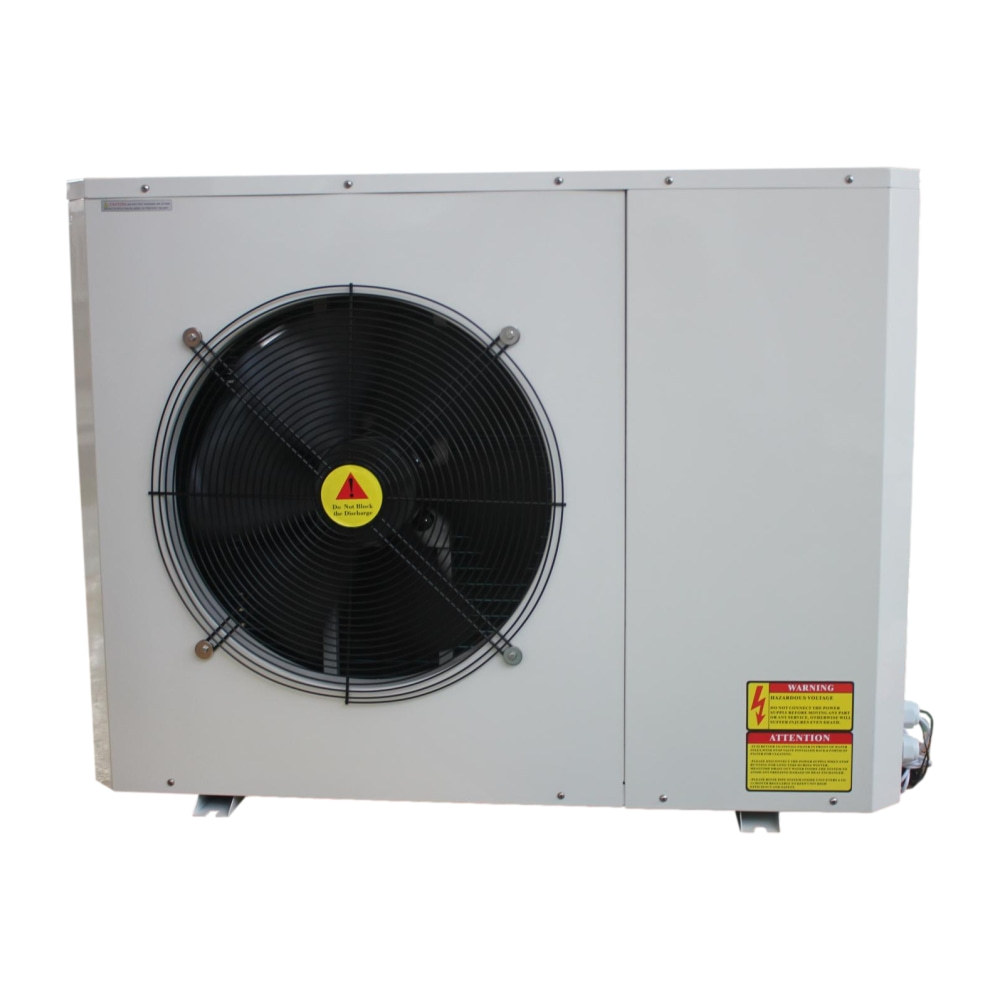
For aquaculture sites in cold-climate regions where winter air temperatures fall below 0°C, Suoher recommends EVI monobloc units like the SHAW-12EVIM shown above. The Enhanced Vapor Injection compressor maintains full heating capacity down to -25°C, which covers northern China, Korea, and European inland aquaculture operations.
60–70% Energy Savings
Consider a 500 m² tilapia pond in southern China that requires 5 kW of continuous heating for 120 days per winter season (December–February). The total heat demand is:
5 kW × 24 h × 120 days = 14,400 kWh of thermal energy
| Parameter | Electric Heater | Heat Pump (COP 4.0) | Difference |
|---|---|---|---|
| Electricity consumed | 14,400 kWh | 3,600 kWh | -75% |
| Electricity cost (¥0.6/kWh) | ¥8,640 | ¥2,160 | -¥6,480 |
| Equipment cost | ¥3,000 | ¥18,000 | +¥15,000 |
| Year 1 total cost | ¥11,640 | ¥20,160 | +¥8,520 |
| Year 2 total cost | ¥11,640 | ¥2,160 | -¥9,480 |
| 3-year total cost | ¥34,920 | ¥22,320 | -¥12,600 |
The heat pump system pays for itself by the end of the second winter season and generates net savings of ¥12,600+ over three years. These calculations use conservative assumptions — actual COP in southern China winters often exceeds 4.5, and tilapia feeding rates at optimal temperature generate additional revenue that dwarf the energy savings.
Payback Example: 500 m² Tilapia Pond
For a more complete picture, consider the biological economics. At 24–26°C water temperature, tilapia feed conversion ratio (FCR) is approximately 1.5 — meaning 1.5 kg of feed produces 1 kg of weight gain. At 18–20°C (unheated winter conditions), FCR deteriorates to 2.5–3.0, and much of the feed energy goes to maintenance metabolism rather than growth. In practice, the heated pond produces 30–40% more fish biomass per kilogram of feed during the winter season, which is worth far more than the electricity savings alone.
The total payback for a 500 m² tilapia pond heat pump system — including energy savings, improved FCR, reduced mortality, and faster growth cycle — is typically 12–18 months in subtropical climates.
Case Study: Tilapia Farm in Guangdong, China
A commercial tilapia farm in Zhaoqing, Guangdong Province, operates twelve 500 m² earthen ponds with a total standing biomass of approximately 60,000 fish. Before 2023, the farm used no water heating — winter water temperatures regularly fell to 16–18°C, and the farm accepted 35–40% over-winter mortality as a normal cost of production. In November 2023, the farm installed six SHPH-13CH heat pumps (two per pond, serving three ponds initially) with a combined heating capacity of approximately 78 kW.
Mortality Reduction Data
| Metric | Previous (Unheated) | With Heat Pump | Change |
|---|---|---|---|
| Winter water temperature | 16–18°C | 25–26°C (±0.5°C) | +8°C |
| Over-winter mortality | 38% | 4.2% | -89% |
| Feed conversion ratio (winter) | 2.8 | 1.6 | -43% |
| Winter growth rate (g/fish/week) | 8 | 22 | +175% |
| Disease treatment cost (per pond) | ¥2,400 | ¥600 | -75% |
| Surviving fish at season end | 3,100 / 5,000 | 4,790 / 5,000 | +1,690 fish |
The mortality reduction alone — from 38% to 4.2% — saved approximately 1,690 fish per pond. At an average market weight of 600g and a farm-gate price of ¥12/kg, each pond generated an additional ¥12,168 in surviving biomass. The six heat pumps (two per pond across three ponds) cost approximately ¥54,000 total, and the three heated ponds generated combined additional revenue of ¥36,504 in the first winter season alone. The payback period on the three-pond pilot was under 18 months.
Yield Improvement
Beyond mortality, the heated ponds produced dramatically better growth performance. At 25–26°C, tilapia continued growing at 22g per fish per week throughout the winter — nearly triple the 8g per week in unheated ponds. This meant the heated ponds reached harvestable size (600g) by March, while unheated ponds did not reach harvest size until June. The earlier harvest allowed the farm to sell into the spring market when tilapia prices were 20–30% higher than the summer glut. The combination of more surviving fish, faster growth, and better market timing tripled the revenue per pond compared to the previous unheated baseline.
SHPH-40DC3: 40 kW DC Inverter Heat Pump
High-capacity DC inverter heat pump for commercial aquaculture, RAS facilities, and large pond systems. The inverter compressor modulates from 28 kW to 40 kW for precise temperature control without cycling losses.
- Heating capacity: 28–40 kW (modulating)
- COP: 4.8–6.3
- Max. water temp: 40°C
- Rated water temp: 27°C (adjustable)
- Water flow: 17.2 m³/h
- Power supply: 380V / 3PH
- Net weight: 165 kg
Aquaculture Heat Pump Specification Checklist
Before purchasing a heat pump for an aquaculture system, verify each of the following specifications. Suoher's engineering team uses this checklist during project consultations to ensure every unit is correctly specified for the target species, water chemistry, and climate.
- 1. Confirm heat exchanger material. Titanium is mandatory for saltwater and brackish water (chloride >500 mg/L). PVC+titanium is the standard for pool and aquaculture units. Never accept copper, cupronickel, or stainless steel heat exchangers for marine applications — they will corrode within 1–3 years.
- 2. Calculate peak heat demand. Use the water volume, target temperature lift, and local design outdoor temperature. Add 20% for evaporation and wind losses. The result is the minimum heat pump capacity. For a 500 m³ pond with a 10°C lift and 24-hour heat-up requirement, the peak demand is approximately 24 kW.
- 3. Select inverter over fixed-speed. Inverter (DC) heat pumps modulate compressor output to match the real-time heat load, which in aquaculture varies with weather, wind, and humidity. The seasonal COP improvement of 15–25% typically justifies the 20–30% higher capital cost.
- 4. Size the temperature sensor location. Place the temperature sensor in the culture water return line — not in the heat pump outlet or the heating loop. The sensor should read the temperature the fish actually experience, with the PID controller compensating for thermal lag in the piping and water volume.
- 5. Plan for summer cooling. In tropical and subtropical regions, summer water temperatures can exceed 32°C, which is lethal for some species. A reversible heat pump can provide chilling in summer and heating in winter, doubling its value. Specify this requirement at order time.
- 6. Verify power supply compatibility. Units above 15 kW heating capacity typically require 380V three-phase power. Confirm transformer capacity, cable sizing, and earth leakage protection with a licensed electrician. Suoher's factory can configure units for 220V single-phase or 380V three-phase on request.
- 7. Consider cascade configuration. For large ponds (>1,000 m²) or multi-pond facilities, multiple smaller units in cascade provide better redundancy and part-load efficiency than a single large unit. If one unit fails, the others maintain temperature while the fault is repaired.
- 8. Specify the control protocol. For RAS integration, the heat pump controller should support Modbus RTU or a compatible protocol to communicate with the central aquaculture management system. Suoher offers RS485 and WiFi control options on DC inverter models.
The Suoher factory in Foshan, China, manufactures both the pool heat pump line (SHPH series with titanium heat exchangers) and the EVI monobloc line (SHAW series for cold-climate applications). For aquaculture projects, the engineering team can customise compressor sizing, control parameters, and heat exchanger configuration to match your target species, water chemistry, and climate conditions.
Request a Custom Aquaculture Heating System Design
Whether you are heating a single tilapia pond, a shrimp hatchery with precise PL-stage temperature requirements, or a full RAS facility with multiple culture tanks, the first step is an accurate heat load calculation. Suoher's aquaculture engineering team provides free system design services — including capacity sizing, equipment selection, cascade configuration, and control protocol specification — tailored to your site's water volume, target temperature, climate, and salinity. Contact the factory with your pond or tank dimensions, target species, and local winter temperature range, or explore the titanium heat exchanger heat pump range and 40kW DC inverter model to see which capacities fit your operation. The same titanium condenser technology that has kept Suoher pool heat pumps running corrosion-free in saltwater pools across 40+ countries is available for your aquaculture project today.