Swimming Pool Heat Pump Troubleshooting: Common Faults and Fixes
- Share
- publisher
- Suoher Heat Pump Team
- Issue Time
- Sep 13,2026
Summary
A practical pool heat pump troubleshooting guide for homeowners, pool techs, and dealers. Six common faults covered: not heating, error codes, low pressure, noise, titanium scaling, and breaker trips — each with field-tested fixes from Suoher engineers. Also includes a four-season preventive maintenance calendar to keep your pool heat pump running through its second decade.
Fault 1: Pool Heat Pump Not Heating — Sizing, Airflow, or Ambient?
If your pool heat pump is running but the water stays cold, the cause is almost always one of three things: an undersized unit, restricted airflow, or an ambient temperature below the unit's stated working range. Before you tear anything apart, spend ten minutes gathering data.
First, check the actual water-vs-setpoint gap. If the controller shows 26 °C and your setpoint is 28 °C after six hours of continuous run, the unit is undersized or starved of heat — not broken. Second, listen for the compressor: a steady low hum means it is running; cycling on-off every 30 seconds means short-cycling from low pressure or overheating. Third, measure inlet and outlet air temperature at the fan grille — a healthy air-source pool heat pump drops the air by 4–6 °C across the evaporator. If the delta is only 1–2 °C, the evaporator is icing or the refrigerant charge is low.
Restrictive airflow is the silent killer. Leaves stuck against the grille, a wall installed too close to the rear, a build-up of scale or pollen on the coil — any of these will cut heating capacity by 30–50 % before the controller throws an error. A titanium-in-PVC heat exchanger cannot fix what a blocked coil causes.
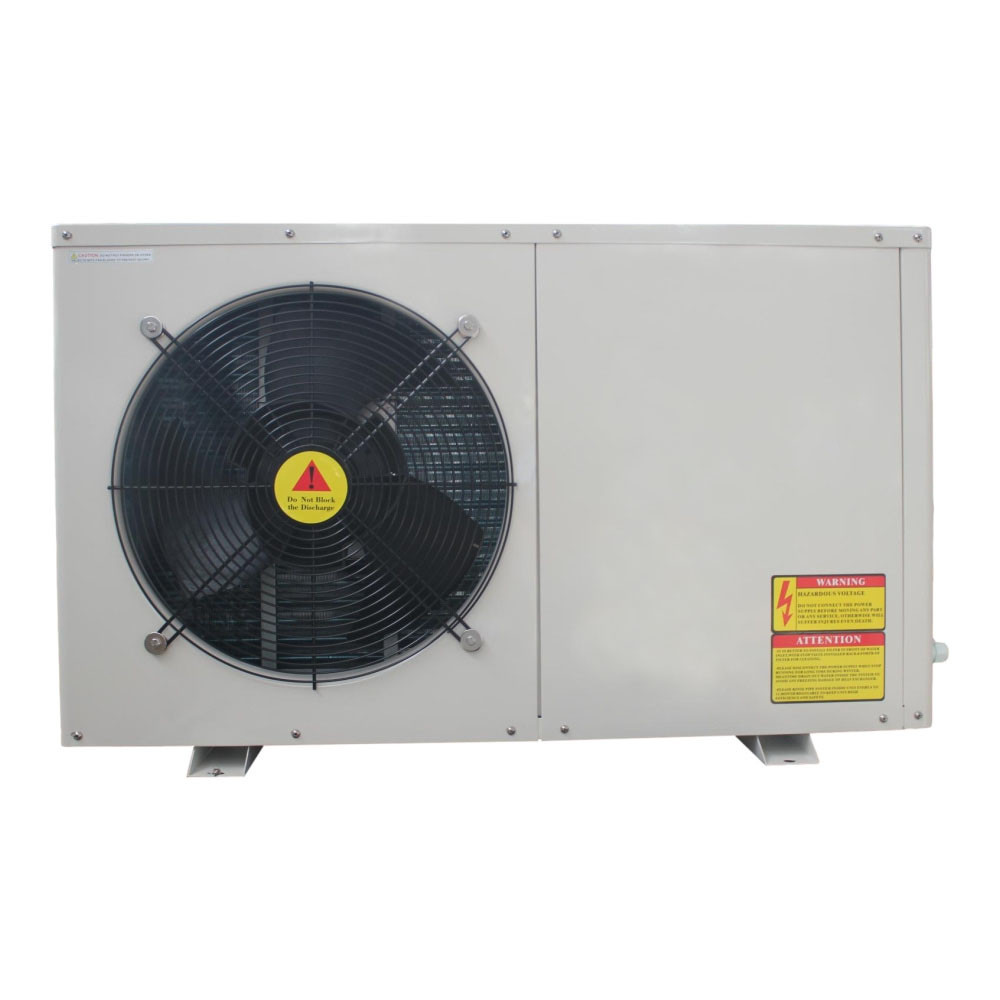
For residential pools up to 40 m³, Suoher's SHPH-11CH and SHPH-13CH units (8.2–10.6 kW heating, COP 4.61–5.88) are usually the right match. For larger pools or year-round heating in temperate climates, drop down to the 40 kW DC inverter line.
SHPH-11CH / SHPH-13CH Swimming Pool Heat Pumps
Compact residential pool heat pump sized right for pools up to 40 m³. PVC + Titanium heat exchanger handles chlorinated or salt water without scaling; on-board low-pressure switch (0.02 / 0.15 MPa) trips before coil freeze ever becomes a fault code. Suoher specs this unit precisely so a 30 m³ pool reaches 28 °C in 24–36 h without summer over-sizing.
View ProductFault 2: Error Codes Decoded — What Your Controller Is Trying to Tell You
Every modern pool heat pump has a small LCD or LED display that flashes a fault code when one of its protection circuits trips. The code itself is rarely a diagnosis — it is a symptom pointing at one of four systems: water flow, refrigerant pressure, coil temperature, or sensor failure.
Common codes by manufacturer family
Below is the most common mapping. Suoher controllers label codes with the prefix P0–P9 (protection) or E0–E7 (sensor / communication), while many European OEM brands use the older PL / EE / FL format. Treat the second column as the symptom; the third column is the system to investigate first.
| Display code | Symptom | First place to look |
|---|---|---|
| P0 / PP | Insufficient water flow | Pump, filter, flow switch paddle stuck |
| P1 / E1 | High-pressure cut-out | Water too hot, restricted flow, over-charge |
| P2 / E2 | Low-pressure cut-out | Refrigerant undercharge, blocked cap tube, evaporator icing |
| P3 / E3 | Coil defrost timeout | Demand-defrost sensor, ambient < -5 °C, fan issue |
| P4 / E4 | Discharge temp high | Low airflow, condenser fouled, overcharge |
| E5 / EE | Communication lost | Loose ribbon, water ingress in control board |
| E6 / FL | Water-inlet sensor open | Sensor lead, thermistor NTC 10 kΩ at 25 °C |
| P7 / EEr | EEPROM / parameter error | Power surge reset; flash firmware if persistent |
The single biggest code-trip on residential units is P0 / PL — flow loss. Before you log a warranty claim, walk to the equipment pad and confirm the circulation pump is primed, the filter is clean, the hair-and-lint basket is empty, and the flow switch paddle is free. Nine times in ten, the code clears once a stuck paddle is nudged back into place.
Fault 3: Low Pressure or Freezing Coil — The Underwater Half of the Problem
The evaporator coil lives behind the fan grille. When the refrigerant pressure drops below the low-pressure switch threshold (typically 0.02 MPa on residential pool units), the switch opens and the compressor is shut down to prevent liquid slugging. Three things cause this in the field:
- Undercharge from a slow leak at a flare fitting, Schrader valve, or factory joint. Recover, leak-test, weigh in R32 / R410A per the nameplate.
- Capillary-tube blockage from moisture or contaminant in the refrigerant loop. Symptoms: pressure bounces on start-up then trips low. Replace the filter drier and the cap tube, evacuate to 500 microns, recharge by weight.
- Evaporator icing from low airflow or a failing defrost sensor. Visible white frost spreading from the coil bottom upward is normal during reverse-cycle defrost; ice that bridges the full coil and does not shed within 8–10 minutes is a fault.
Field note from Suoher service: 70 % of low-pressure complaints on the 11–13 kW residential line are actually defrost-sensor issues, not refrigerant leaks. Check the coil temperature sensor mounting clip before pulling a vacuum.
For commercial pools (40 kW and up), persistent low pressure usually points at scale build-up inside the titanium condenser instead — see Fault 5 below. A quick tell: if the unit trips P2 / E2 only when the pool is above 30 °C and the outdoor air is above 28 °C, the cap tube is partially restricted by desiccant carry-over.
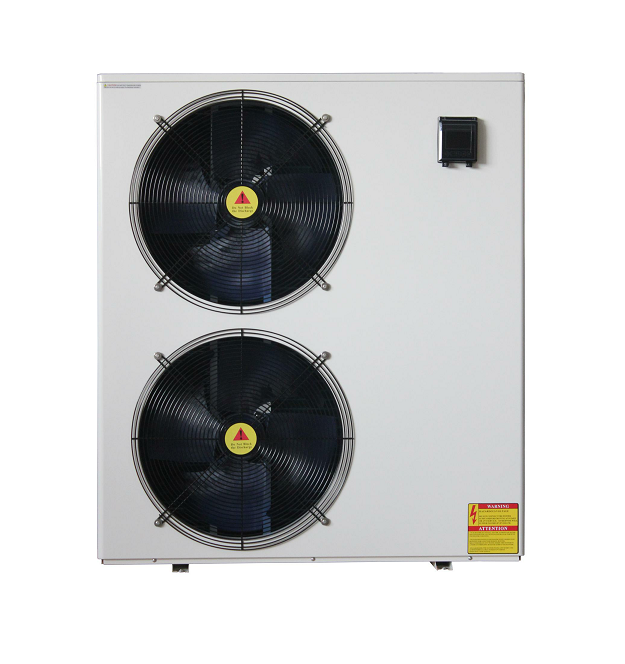
SHPH-40DC3 40kW DC Inverter Swimming Pool Heat Pump
The 40DC3 uses a variable-frequency compressor that ramps from 28 to 40 kW as pool load falls off, keeping the unit out of cycling stress and away from low-pressure trip zones. WiFi controller surfaces the actual fault code plus a 7-day log — when a service tech arrives on site, the trip history is already on their phone. Suoher's DC inverter line is the easiest pool heat pump to remote-diagnose precisely because the controller records what the sensors saw before the cut-out.
Learn MoreFault 4: Noise and Vibration — What Is Normal, What Is Not
Pool heat pumps are quieter than air-source HVAC but not silent. A brand-new unit emits 48–58 dB(A) at 1 m — about the level of a quiet conversation. Anything louder, sharper, or rhythmic is a service item.
- Low hum that fades after 10 minutes — normal compressor ramp-up on inverter units.
- Ticking or clicking — thermal expansion of the copper shells as the unit shifts from heating to defrost. Benign if intermittent.
- Grinding or metallic scraping — fan blade touching the grille, or a failing compressor bearing. Stop the unit and inspect.
- Constant high-frequency whine — refrigerant slugging at the cap tube. Indicates undercharge or moisture. Call a tech.
- Rattling on wind — mounting feet loose, or unit not bolted to a vibration pad. Re-anchor to a concrete pad with rubber isolators.
Vibration damage compounds. A unit running at 60 dB today will be running at 65 dB in twelve months if the rubber feet are hardened or missing. Suoher ships its residential pool heat pumps with pre-fitted anti-vibration mounts and an installation manual that explicitly calls out a 100 mm clear zone on all four sides — keep that clear, and the unit will stay quiet through its second service cycle.
Fault 5: Titanium Exchanger Scaling — The Slow, Silent Capacity Killer
Titanium survives chlorine, salt, and bromine — but it does not protect itself from calcium scale. In a pool where the calcium hardness is above 600 ppm, the Langelier Saturation Index drifts positive, and calcium carbonate precipitates onto the inside wall of the titanium tubes. The first symptoms are subtle: longer heat-up times, then a gradual drop in COP. By the time a fault code trips, you have already lost 15–25 % of your heat transfer.
Cleaning a scaled titanium exchanger requires a closed-loop acid flush, never an open pour. The recommended chemistry is a 5–10 % phosphoric or citric acid solution circulated for 30–60 minutes at 40 °C, then a neutralizing rinse and a fresh water refill. Hydrochloric (muriatic) acid works but is more aggressive on the tube end-roll joints — Suoher's service team prefers citric on residential units for that reason.
The most reliable prevention is to keep pool water chemistry inside the Langelier Index range -0.3 to +0.3, with calcium hardness between 200–400 ppm. Install a sacrificial anode on the salt-chlorinator cell to capture stray current, and run the heat pump's circulation pump for at least eight hours a day so biofilm does not gain a foothold on the tube wall.
Fault 6: Tripping Breaker — The Electrical Half of the Problem
A pool heat pump that blows its breaker on start-up is almost always fighting one of three enemies: a weak breaker, a loose lug, or a locked rotor.
| Symptom | Likely cause | First check |
|---|---|---|
| Trips immediately on start | Short to ground | Megger the compressor and fan windings |
| Trips after 2–3 seconds | Locked rotor | Try to hand-turn the compressor/fan |
| Trips randomly | Weak breaker / undersized supply | Voltage drop test under load |
| Trips only on defrost | High inrush from auxiliary heater stage | Time the trip against the defrost schedule |
Wire sizing is the silent partner here. A 13 kW residential pool heat pump at 220 V single-phase draws 36 A steady plus a 60–80 A inrush on compressor start. On a long cable run from a remote panel, voltage drop can drag the motor below its pull-out torque, the current climbs, the breaker trips, and everyone blames the compressor. Suoher's installation manual specifies a maximum 3 % voltage drop on the supply cable — measure at the compressor terminals under load, not at the breaker.
Preventive Maintenance Calendar — A Year-Round Routine
The cheapest fault is the one that never happens. Suoher's service desk hands out the same four-season calendar to every OEM and dealer; copying it here for your trade reference.
- Monthly — visually clear the coil of leaves, confirm the condensate drain is open, listen for new noises on start-up.
- Quarterly — clean the filter basket, check water flow at the flow-switch paddle, verify the controller's setpoint vs actual pool temperature drift is < 1 °C.
- Bi-annually (spring and autumn) — pull the service panel, vacuum the evaporator coil from the inside out, check electrical lug torque to 1.2 N·m, inspect the titanium tube bundle through the end-cap for early scale.
- Annually — weigh the refrigerant (a 5–10 % loss is normal over five years; more than that means a leak), replace the flow-switch paddle if worn, refresh the controller firmware if the unit has WiFi.
Get Your Pool Heat Pump Diagnosed: Talk to a Suoher Service Engineer
If your unit is throwing a fault code you cannot clear, or your pool is taking noticeably longer to heat than last season, send Suoher's service desk three pieces of information: the unit's model and serial plate (the QR code on the side panel pulls up the full build sheet), the last 7 days of fault-code history if your controller is WiFi-equipped, and a short video clip of the unit starting up. From those three signals the engineering team can usually tell you in one email whether you are looking at a five-minute reset or a service visit — and they will quote the spare parts at OEM pricing instead of dealer markup.
For pool builders and dealers handling a fleet of units, the SHPH-40DC3 ships with a built-in 7-day fault log and a WiFi controller that pushes trip events to a phone app — meaning your service team sees the fault on their phone before the homeowner calls in. Talk to a Suoher engineer about spec'ing the DC inverter line on your next hotel, school, or residential development project, and the diagnostic headaches on this list largely disappear.