Heat Pump + Solar PV: Hybrid Renewable Systems for Lower Operating Costs
- Share
- publisher
- Suoher Heat Pump Team
- Issue Time
- Sep 12,2026
Summary
Practical guide to pairing DC inverter heat pumps with residential solar PV: time-shift PV surplus into DHW and buffer tanks, push self-consumption from 30% to 65-80%, real Bavarian retrofit with SHAW-9DM1/K, payback 2 months via SG-Ready, four architecture options, common installer mistakes.
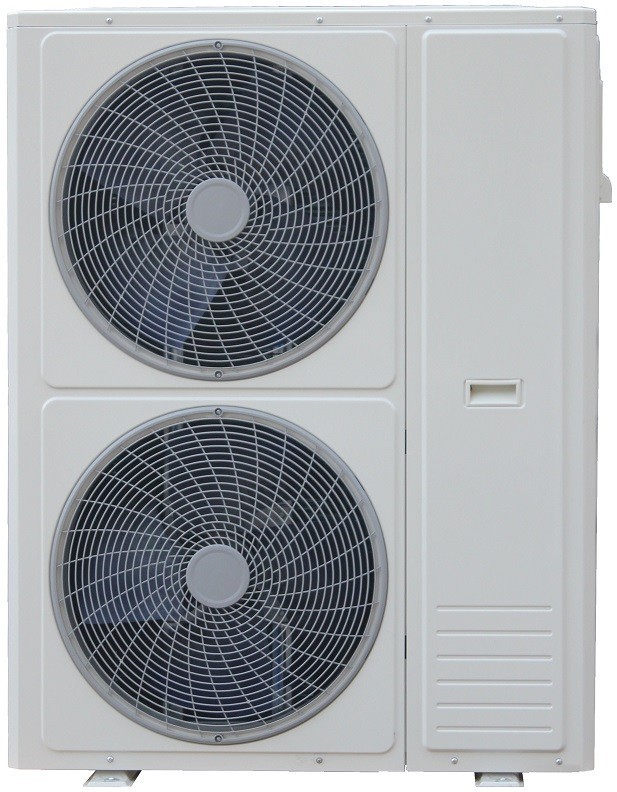
A solar PV array on a house roof and a heat pump in the utility room are, on paper, the cleanest possible energy pairing: the panels generate electricity at midday when the sun is high, the heat pump uses that electricity to move heat from the outside air into the home or hot water tank. The challenge is that they do not always run at the same time — solar peaks around noon, while most heat pump demand falls in the morning, evening, and shoulder seasons. Modern inverter heat pumps like Suoher's DC inverter line, paired with smart controls, can shift their load into the solar window and push self-consumption rates from a typical 30–35% to 55–70%. This guide explains the architecture options for a heat pump + solar PV hybrid, how to size the PV array for a real household, what the actual savings look like with and without battery storage, and how Germany's SG-Ready standard turns the heat pump into a flexible load that helps the grid as well as the homeowner.
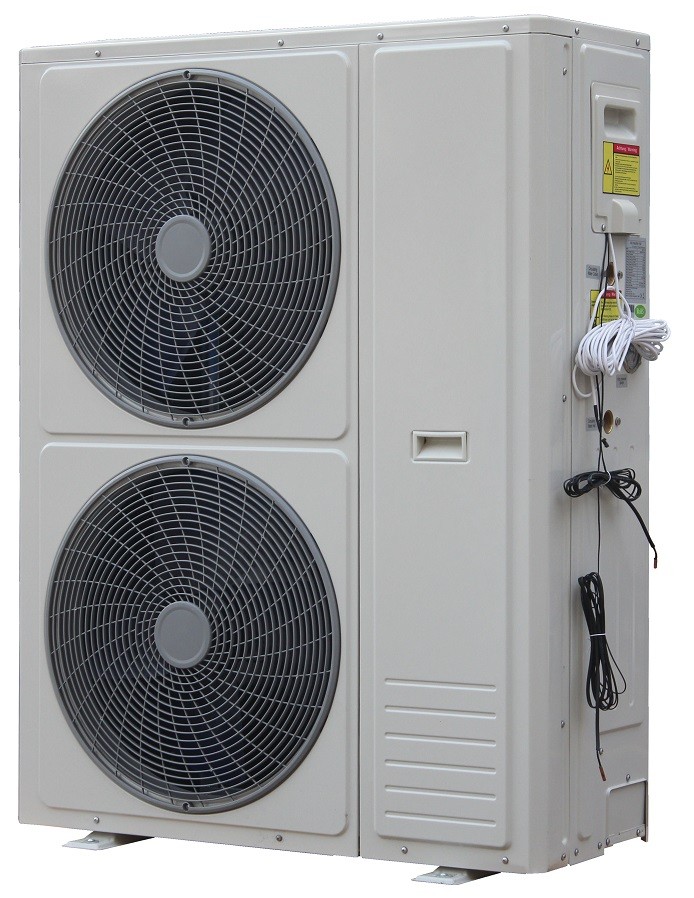
The Suoher SHAW-15DM3/K 15kW DC inverter monobloc heat pump paired with a residential PV inverter — the most common pairing in new German and Dutch installations. The DC inverter compressor ramps its electrical draw from 1.0 kW to 5.5 kW to follow the available solar generation, instead of cycling on and off like a fixed-speed unit.
Why Heat Pump + Solar PV Is a Natural Pair
Across Europe, residential solar PV capacity passed 250 GW in 2025, and a heat pump now ships for every three to four new rooftop PV systems (European Heat Pump Association and SolarPower Europe joint data, Q4 2025). The combination is more than a marketing story: the two technologies solve each other's biggest weakness. Heat pumps use electricity, so they benefit from any self-generated PV power that displaces grid imports at €0.20–0.35/kWh. PV arrays produce most of their energy around midday, when household load is typically low — so without a flexible load like a heat pump, 40–60% of solar generation is exported to the grid at €0.05–0.10/kWh, undercutting the economics of the installation.
The pairing becomes truly powerful when the heat pump can shift its electrical draw into the solar window. A well-controlled DC inverter heat pump with a buffer tank can pre-heat domestic hot water or thermally charge a buffer between 10:00 and 14:00, then coast through the evening peak without any grid electricity. Suoher's DC inverter heat pumps support this operating mode through a built-in smart-grid input and an external SG-Ready contact that lets a PV inverter, energy management system, or home battery signal the heat pump when surplus solar is available.
Time-Shifted Generation vs Consumption
The mismatch between solar production and household consumption is the most important concept in any PV-plus-heat-pump design. Consider a four-person home in southern Germany with 10 kWp of rooftop PV and an annual electricity demand of 4,500 kWh:
| Time of Day | Typical Household Load (without heat pump) | Typical PV Generation (10 kWp) | Surplus / Deficit |
|---|---|---|---|
| 06:00 – 10:00 (morning) | 1.5 kW | rising 0 → 6 kW | Deficit → small surplus by 10:00 |
| 10:00 – 14:00 (solar peak) | 0.8 kW | 6 → 9 kW | Surplus 4–7 kW exported |
| 14:00 – 17:00 (afternoon) | 1.2 kW | 9 → 3 kW | Surplus 1–6 kW |
| 17:00 – 22:00 (evening peak) | 2.5 kW | 0 kW | Deficit, full grid import |
| 22:00 – 06:00 (night) | 0.5 kW | 0 kW | Deficit, full grid import |
Without a flexible load, more than half of the solar generation is exported at low feed-in tariff, and the full evening peak is imported at full retail rate. Adding a heat pump that can run during the midday surplus window — for DHW pre-heating, buffer charging, or even a slight room-temperature boost — reduces both export loss and evening grid import.
Grid Price Spreads and Self-Consumption Economics
The second driver of the heat pump + PV pairing is the widening gap between retail and feed-in tariffs. In Germany in 2026, residential retail electricity averages €0.32/kWh while feed-in tariffs for new residential PV systems are €0.08–0.10/kWh. Every kilowatt-hour of solar electricity that is self-consumed instead of exported therefore saves roughly €0.22–0.24/kWh. A heat pump that shifts 2,500 kWh/yr of electrical demand into the solar window produces a direct bill saving of €550–600/yr before any subsidy. In the Netherlands, Belgium, and Austria the spread is similar; in the UK and Italy it is smaller but still positive.
System Architectures: How the Heat Pump Talks to the PV
There are four architectural options for combining a residential heat pump with a solar PV array. Each has different cost, complexity, and self-consumption upside. Suoher's engineering team typically recommends option 2 or 3 for typical European family homes, and option 4 for off-grid or weak-grid sites.
1. Grid-Tied with Self-Consumption (No Battery)
The simplest and most common architecture. A standard grid-tied PV inverter feeds solar electricity into the home distribution board, and a separate heat pump runs on the same supply. No smart coordination is installed. Self-consumption is typically 30–35% because the heat pump only happens to run when the sun is shining. This is the baseline against which smarter architectures are measured.
2. Smart-Grid / SG-Ready Heat Pump (No Battery)
The PV inverter is fitted with an export-metering relay or a home energy management system (HEMS) — products from SMA, Fronius, SolarEdge, E3/DC, Tigo, and Enphase all support this — and the relay sends a dry-contact signal to the heat pump's SG-Ready input. When surplus export is detected, the heat pump receives a permission to operate at elevated capacity and preferentially heats the buffer tank or DHW cylinder to a higher temperature setpoint (typical +5°C boost). When export falls, the heat pump reverts to its normal schedule. This pushes self-consumption to 45–60% without battery storage. Suoher's SHAW-9DM1/K and SHAW-15DM3/K both ship with SG-Ready contacts as standard.
3. Battery Storage with PV Coupling
A home battery (typically 5–10 kWh LiFePO4) is added to the PV system, controlled by the same HEMS. The battery charges from midday surplus and discharges in the evening. The heat pump can run on stored solar electricity in the evening, pushing self-consumption to 65–80%. This is the most expensive option because batteries add €4,000–7,000 to a system, but in markets with strong battery subsidies (Germany's KfW 270, Italy's 110% superbonus legacy, Austria's PV-plus-storage grant) the payback is still attractive.
4. AC-Coupled Off-Grid / Island Mode
For remote sites, weak-grid rural properties, or markets with unreliable public electricity, the heat pump is paired with a hybrid inverter and battery bank sized for full autonomy. Self-consumption is by definition 100% because there is no grid to export to. Suoher's SHAW-9DM1/K is a common choice for off-grid residential cabins and farmhouses because its 1.0–3.4 kW variable input power draw is easy to balance with a 5 kW hybrid inverter and 10–15 kWh battery bank.
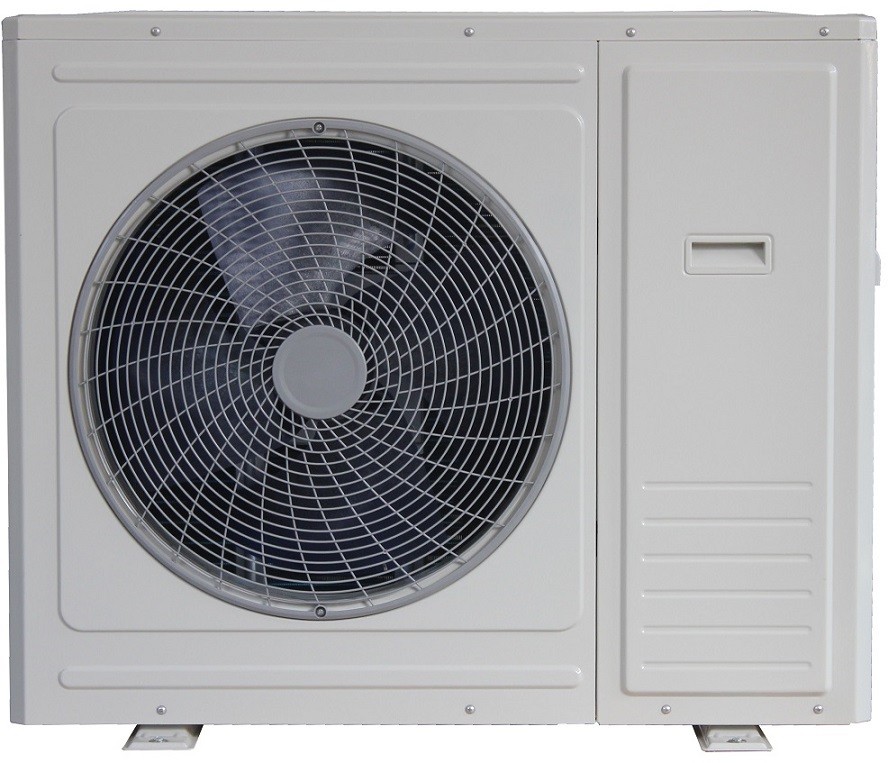
The Suoher SHAW-9DM1/K — a 9kW DC inverter monobloc — paired with a 200-litre DHW buffer tank. The buffer tank is the key component in a heat pump + PV installation: it decouples heat generation from heat use, giving the PV surplus a thermal store to charge.
Sizing the PV Array for a Heat Pump
The most common design mistake is sizing the PV array to cover only the household's daytime baseload and ignoring the heat pump's additional electrical demand. The correct approach is to size PV to cover the combined annual electricity load, then verify that the heat pump's hourly demand profile can be matched with a reasonable buffer tank. Suoher's engineering team uses the following three-step method for European residential installations.
Step 1 — Calculate Annual kWh Demand
Sum three components: (a) baseline household electricity (typically 2,500–4,500 kWh/yr for a European family home), (b) the heat pump's heating and DHW electricity (depends on climate and SCOP — typical 3,500–7,000 kWh/yr), and (c) any EV charging (0–4,000 kWh/yr). For a typical detached house with a heat pump and one EV:
- Baseline household: 3,500 kWh/yr
- Heat pump heating + DHW: 5,500 kWh/yr (SCOP 3.0, climate zone central Europe)
- EV charging (12,000 km/yr at 17 kWh/100 km): 2,040 kWh/yr
- Total annual electricity demand: 11,040 kWh/yr
Step 2 — Size the PV Array
In central and northern Europe, 1 kWp of well-oriented rooftop PV produces 850–1,000 kWh/yr. To meet ~70% self-consumption target for the combined load, size the array to produce about 7,500–9,000 kWh/yr:
- PV array size: 9 kWp (27 panels at 335 Wp each)
- Estimated annual generation: 8,100 kWh/yr (at 900 kWh/kWp, Germany)
- Direct self-consumption (no smart control): ~3,200 kWh/yr (40%)
- Direct self-consumption with SG-Ready heat pump: ~5,200 kWh/yr (64%)
This is a 4 kW heat pump household — exactly the residential segment that Suoher's SHAW-9DM1/K and SHAW-15DM3/K are designed for.
Step 3 — Example: A 4 kW Heat Pump Household
Consider a 165 m² renovated home in Bavaria with a Suoher SHAW-9DM1/K supplying underfloor heating and DHW. Annual heat pump electricity demand is 4,800 kWh (SCOP 3.1 at the location), household baseload is 3,200 kWh, EV adds 2,000 kWh, total 10,000 kWh/yr. A 9 kWp PV array produces 8,100 kWh/yr. Without smart control, 3,650 kWh (45%) is self-consumed and 4,450 kWh is exported. With SG-Ready control of the heat pump, self-consumption rises to 5,500 kWh (68%) and exports fall to 2,600 kWh. The annual bill saving vs a no-PV baseline is €1,400 (Germany retail €0.32/kWh, feed-in €0.08/kWh, plus €0.07/kWh avoided grid fee on the self-consumed share).
Real Savings Analysis: Self-Consumption Rate and Payback
The payback of a heat pump + PV system depends on three numbers: installed cost, self-consumption rate, and the retail minus feed-in tariff spread. Suoher's engineering team modelled four scenarios for a Bavarian case study in mid-2026. All figures use the same baseline load (10,000 kWh/yr household + heat pump + EV) and the same 9 kWp PV array. Only the storage and control architecture changes.
| Scenario | Self-Consumption | Exported Solar | Annual Bill Saving vs No PV | Incremental Cost | Payback |
|---|---|---|---|---|---|
| No smart control, no battery | 3,650 kWh (45%) | 4,450 kWh | €870 | €0 (PV only) | — (baseline) |
| SG-Ready heat pump, no battery | 5,500 kWh (68%) | 2,600 kWh | €1,400 | €200 (HEMS + relay) | 2 months |
| SG-Ready heat pump + 5 kWh battery | 6,800 kWh (84%) | 1,300 kWh | €1,780 | €4,500 | 3.7 years |
| SG-Ready heat pump + 10 kWh battery | 7,500 kWh (93%) | 600 kWh | €1,940 | €7,500 | 5.2 years |
The table shows the central design insight clearly: the cheapest, fastest-payback improvement is adding an SG-Ready signal to the heat pump, which Suoher's K-series heat pumps already support. Battery storage adds further self-consumption but the incremental payback stretches, because each additional kilowatt-hour of battery-stored self-consumption displaces an already-low evening grid import.
Why a Buffer Tank Is Almost Always Worth It
A 200–300 litre DHW buffer tank or a 100–200 litre heating buffer adds €400–700 to the system and pays for itself within the first year simply by enabling SG-Ready operation. Without a buffer, the heat pump must deliver heat at the exact moment solar surplus exists; with a buffer, the heat pump can over-produce and store the thermal energy for use later. Suoher's installation manual for the SHAW-9DM1/K and SHAW-15DM3/K explicitly recommends a buffer tank whenever the heat pump is paired with PV.
Germany SG-Ready: The Standard Worth Knowing
SG-Ready (Smart Grid Ready) is a labelling scheme developed by the German Heat Pump Association (Bundesverband Wärmepumpe, BWP) and adopted by Suoher and most major European heat pump manufacturers. An SG-Ready heat pump has two dry-contact inputs that an external energy manager can use to signal four operating modes:
- Mode 1 (Normal): Heat pump runs to its normal schedule. No intervention.
- Mode 2 (Surplus encouraged): External signal indicates surplus solar. Heat pump is permitted (and encouraged) to run at elevated capacity and raise buffer / DHW setpoints by 3–5°C.
- Mode 3 (Surplus mandated): External signal mandates operation. Heat pump must run, even if it would normally cycle off. Setpoints can be raised further.
- Mode 4 (Hard off): External signal blocks operation (used by utilities during peak grid stress or by owners during high-tariff windows).
For PV integration, modes 2 and 3 are the relevant ones. A simple export-meter relay from the PV inverter closes the SG-Ready contact whenever export crosses a configurable threshold (typically 1.5–2.0 kW), and the heat pump responds. Suoher's SHAW-9DM1/K and SHAW-15DM3/K ship with the SG-Ready input pre-wired to a labelled two-pin terminal inside the unit's electrical enclosure, so installation is a 10-minute job for any qualified electrician.
Common Mistakes in Heat Pump + PV Installations
Suoher's engineering and service teams have reviewed several hundred European heat pump + PV retrofit projects since 2022. The same five mistakes come up repeatedly. Avoiding them saves money and frustration.
1. Undersizing the PV Array
Many installers size the PV array to the household baseload (3,000–4,000 kWh/yr) and ignore the heat pump. The result is that almost all solar generation is consumed and the heat pump still draws 4,000–6,000 kWh/yr from the grid. A correctly sized array for a heat pump household is 8–10 kWp, not 4–6 kWp.
2. Buying a Fixed-Speed Heat Pump
Fixed-speed (on/off) heat pumps cycle between full power and zero. They cannot ramp down to soak up 0.5 kW of solar surplus, so any PV surplus that exceeds their minimum load is exported. An inverter heat pump ramps from 20% to 100% of capacity and matches solar surplus far better. Suoher's DC inverter line is engineered specifically for this operating mode.
3. No Buffer Tank
A heat pump without a buffer must run when heat is needed, not when electricity is cheap. With a 200-litre buffer, the heat pump can produce heat at midday and store it for the evening peak. The cost of a buffer tank (€400–700) is recovered in the first year through higher self-consumption.
4. Forgetting SG-Ready Wiring
SG-Ready contact wiring is trivial but easy to forget during a busy install. Pull the two-core cable from the PV inverter to the heat pump electrical enclosure during the same job — retrofitting it later requires opening the heat pump again, which costs €200–400 in service labour.
5. Ignoring Tariff Structures
In Germany, time-of-use tariffs from Octopus Energy, Tibber, and E.ON now offer three- to four-cent discounts per kWh for heat pump load shifted outside the 17:00–21:00 evening peak. A Suoher heat pump with SG-Ready can respond to these dynamic tariffs automatically. Customers who use this combination save an additional €200–400/yr beyond the PV self-consumption saving.
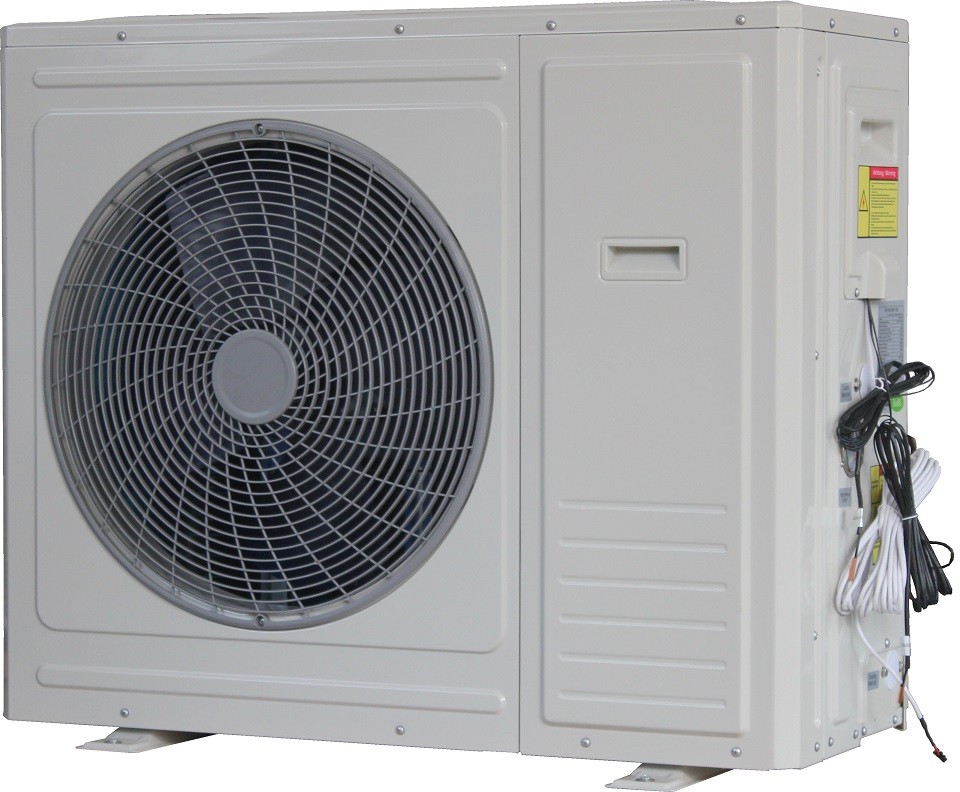
A Suoher SHAW-9DM1/K installed in a Bavarian retrofit. The PV inverter on the wall (left) connects to the heat pump's SG-Ready contact via the HEMS controller (right). When the PV array exports more than 1.8 kW, the controller closes the contact and the heat pump is permitted to over-produce and charge the buffer tank.
Suoher SHAW-9DM1/K — 9 kW DC Inverter Monobloc Heat Pump
K-series DC inverter monobloc engineered for SG-Ready PV pairing. Variable input power 1.0–3.4 kW matches residential PV surplus windows cleanly. Compact single-phase 220V package suited to European household electrical infrastructure.
- Heating capacity: 5.1 – 8.9 kW
- Heating power input: 1.98 – 3.39 kW
- COP (A7/W35): 1.5 – 4.49
- Max water temperature: 60°C
- Power supply: 220V / 1PH / 50Hz
- SG-Ready contact: pre-wired as standard
Pairing Your Heat Pump With PV: A Practical Next Step
A heat pump paired with rooftop solar PV is one of the highest-impact energy investments a European homeowner can make in 2026. The combination typically saves €1,200–2,000/yr on operating cost versus a grid-only heat pump, and €2,500–3,500/yr versus a gas boiler baseline. The technical prerequisites are simple: an inverter heat pump with an SG-Ready contact (Suoher's K-series ships this as standard), a PV inverter with export-metering relay, a 200-litre buffer tank, and a half-day of electrician work to wire it all together.
Suoher's engineering team helps importers, distributors, and installers scope PV-coupled heat pump projects from the early sizing stage through commissioning. We provide EN 14511 performance data at every 5°C ambient step so the PV self-consumption model can be tuned to the local climate, and we can pre-configure the SG-Ready logic for the specific home energy management system (HEMS) you deploy — SMA, Fronius, E3/DC, SolarEdge, Enphase, Tigo, Huawei, or any other platform that exposes a dry-contact.
If you are evaluating whether the SHAW-9DM1/K or the SHAW-15DM3/K fits a specific residential PV project — or you want a paired OEM configuration with custom HEMS logic — send Suoher's heat pump team the household load profile, the planned PV array size, and the buffer tank dimensions. We will return a sizing model, expected self-consumption rate, and an indicative payback within two working days.
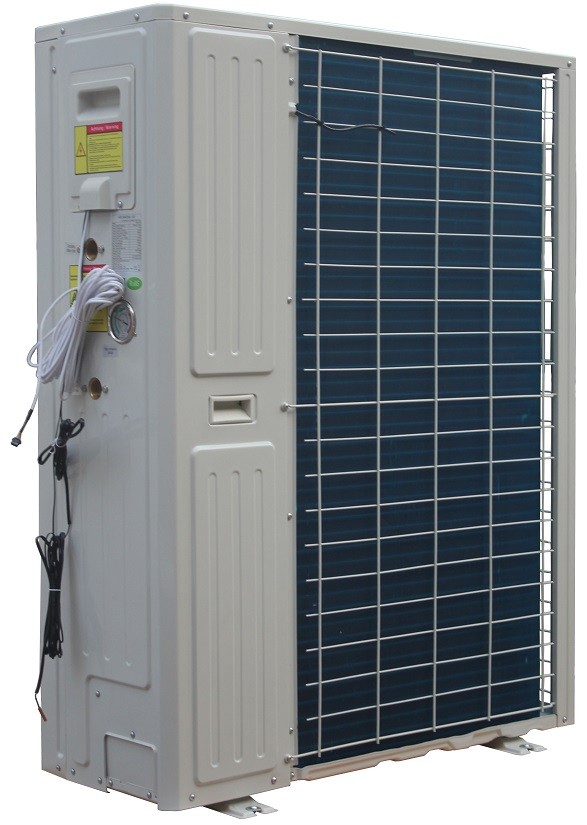
Suoher SHAW-15DM3/K — 15 kW DC Inverter Heat Pump
15 kW three-phase DC inverter monobloc for larger homes and light-commercial PV-paired projects. Heating capacity 8.9 – 15.2 kW, COP up to 4.43 at A7/W35. Three-phase 380V supply suits new-build German, Dutch, and Austrian residential installations.
- Heating capacity: 8.9 – 15.2 kW
- Heating power input: 3.43 – 5.51 kW
- COP (A7/W35): up to 4.43
- Max water temperature: 60°C
- Power supply: 380V / 3PH / 50Hz
- Noise: 58 dB(A)