Air Source vs Ground Source vs Water Source Heat Pumps: Full Comparison
- Share
- publisher
- Suoher Heat Pump Team
- Issue Time
- Aug 25,2026
Summary
Compare ASHP, GSHP and WSHP on efficiency (COP/SCOP), installation cost, maintenance, lifespan and 20-year total cost of ownership. Includes a side-by-side table and project-specific recommendations.
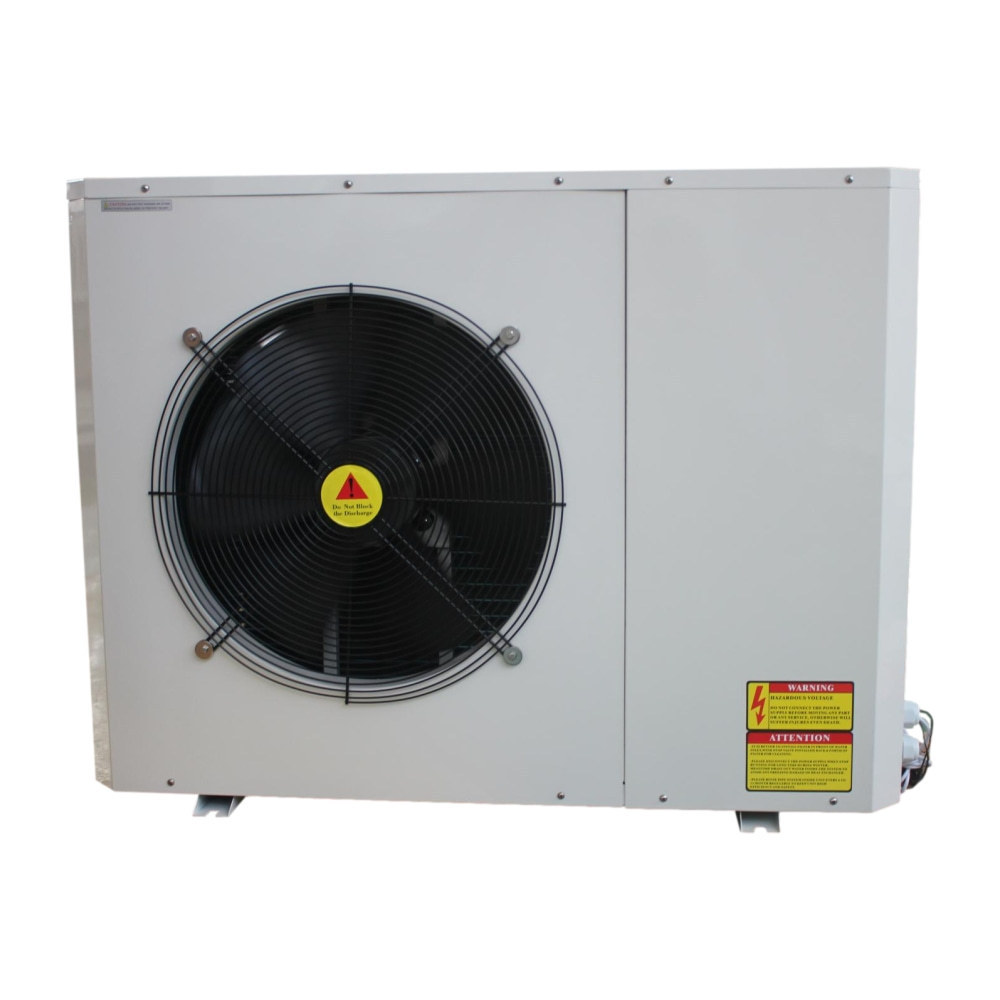
Three Sources of Renewable Heat
If you specify, install, or buy heat pumps for a living, you have already noticed that the term “heat pump” hides three different families of equipment. They pull heat from three different reservoirs: outdoor air, the ground beneath your feet, and a nearby body of water. Each source has a different temperature profile, requires a different installation, and delivers a different efficiency curve. Picking the wrong one for a given project is one of the most expensive mistakes a heat pump buyer can make.
This guide lays out air source heat pumps (ASHP), ground source heat pumps (GSHP), and water source heat pumps (WSHP) on the same axes: how they work, what they cost to install, how efficient they actually run in the field, what maintenance they need, how long they last, and which climate and project each one suits best. The data is drawn from public sources (IEA, US DOE, ENERGY STAR, EN 15450), manufacturer datasheets, and field experience from project engineers who commission these systems across Europe, North America and Australia.
Air Source Heat Pumps (ASHP)
An ASHP uses a vapour-compression cycle to lift heat from outdoor air into your building or hot water tank. Air at -10 °C still holds usable thermal energy; the unit simply has to compress the refrigerant harder to lift it to a useful temperature. Modern inverter-driven ASHPs modulate compressor speed from about 20% to 100% of capacity, which is why they outperform older fixed-speed units by 20–30% on annual energy use.
How they work
Ambient air is drawn across an outdoor fin-coil evaporator. Liquid refrigerant inside the coil absorbs heat from the air, boils into a low-pressure vapour, and is sucked into a compressor. The compressor raises the vapour to a high-pressure, high-temperature gas, which then condenses in a plate or finned heat exchanger, dumping heat into the building's hydronic circuit or DHW tank. The pressure drops back through an expansion valve and the cycle repeats. Cold-climate EVI (enhanced vapour injection) variants add a flash-tank and an intermediate injection port to lift heating capacity at sub-zero ambient conditions — covered in detail in our EVI technology deep dive.
Typical COP range
Under EN 14511 test conditions (A7/W35 — 7 °C air, 35 °C water), a quality ASHP delivers a COP of 3.0–4.5. At colder design conditions (A-7/W35), COP drops to 2.2–2.8, and capacity falls 10–30% from nameplate. Suoher's DC inverter ASHPs hold COP above 2.5 at -15 °C thanks to their wider heat-exchanger surface and brushless DC compressor design.
Pros and cons
- Pros: Lowest installed cost (typically €800–€1,800 per kW heating capacity in Europe; USD 1,200–USD 2,500 per system in the US). No drilling or excavation needed. Retrofit-friendly — most existing radiator or underfloor circuits can be reused. Wide model range from 3 kW apartments to 90 kW commercial units.
- Cons: Capacity and efficiency both drop as outdoor temperature falls. Defrost cycles consume energy and produce cold air discharge. Outdoor fan noise requires siting consideration. Larger monoblock footprints and visible refrigerant lines on the building exterior.
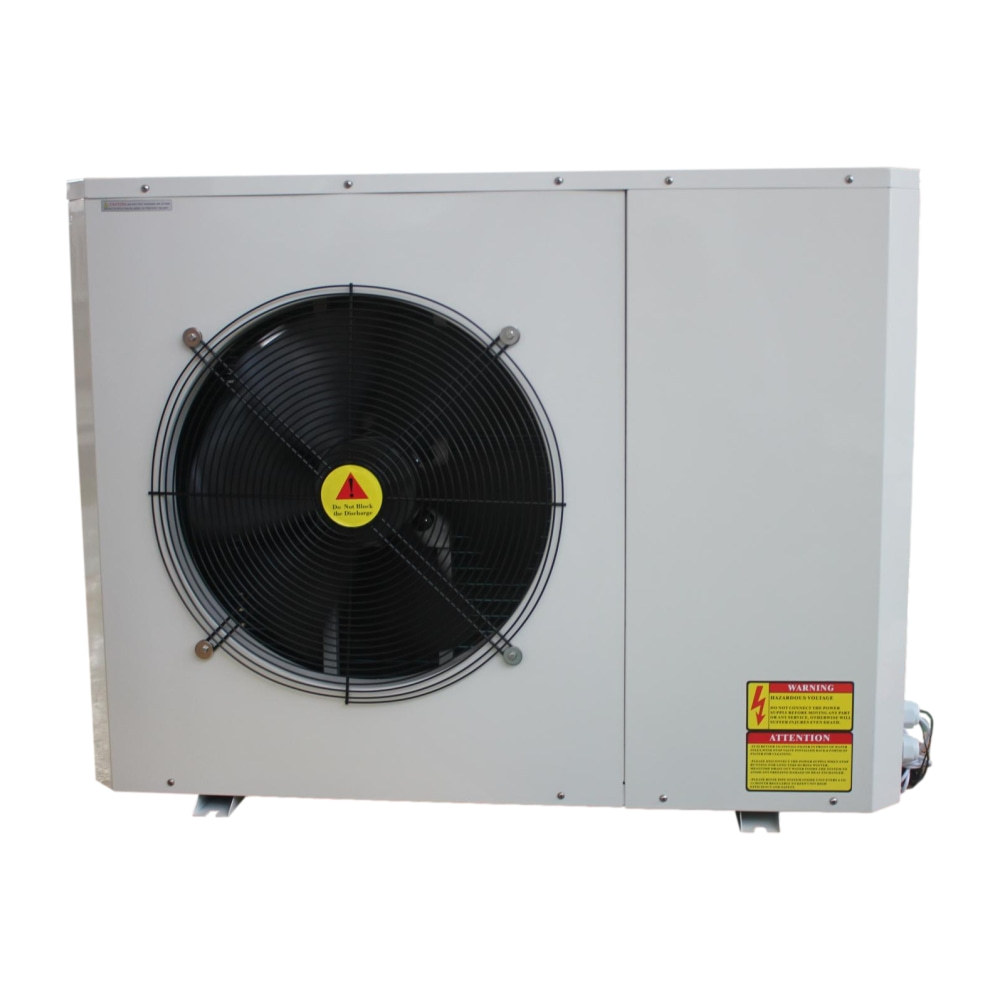
Modern ASHP monoblocs (Suoher SHAW-12EVIM shown) install against an outside wall and need no indoor refrigerant work — a major simplification versus split systems.
Ground Source Heat Pumps (GSHP)
A GSHP uses the relatively stable temperature of the top 50–200 metres of earth as its heat source (or sink, in summer cooling mode). Below about 10 metres depth, ground temperature stays close to the local annual mean air temperature — between 8 °C and 14 °C across most of Europe and the US. That stability is why GSHPs deliver the highest seasonal efficiency of any electric heat pump.
Ground loop types
There are two main loop architectures. Closed-loop systems circulate a food-grade propylene glycol or antifreeze mix through a buried HDPE pipe network. Horizontal loops need roughly 1.5–2.5 m² of trench area per kW of heating capacity and are cheap where land is plentiful. Vertical boreholes (50–150 m deep) need less surface area but cost more per hole and require a drilling rig. Open-loop (water-source) systems draw groundwater directly, pass it through a plate heat exchanger, and return it to a recharge well. Open loops avoid glycol and drilling but require adequate flow and a clean water source.
Typical COP range
Because the ground temperature is far more stable than outdoor air, GSHPs hold a COP of 3.5–5.0 across the heating season. SCOP values of 4.0–5.0 are routinely measured on European projects after the first year of operation, when the borehole has reached thermal equilibrium.
Cost and payback
The catch is upfront cost. A 10 kW residential GSHP system with borehole installation runs €15,000–€25,000 in most European markets and USD 18,000–USD 30,000 in the US. That is roughly double the cost of an equivalent ASHP. Federal and state incentives narrow the gap — the US IRA 25D credit (where still available after recent extensions), Germany's BAFA/ISFP subsidy (up to 40% of eligible cost), and various provincial programmes in Canada can return 30–50% of installed cost. Payback versus ASHP then falls to 4–7 years for well-insulated new builds.
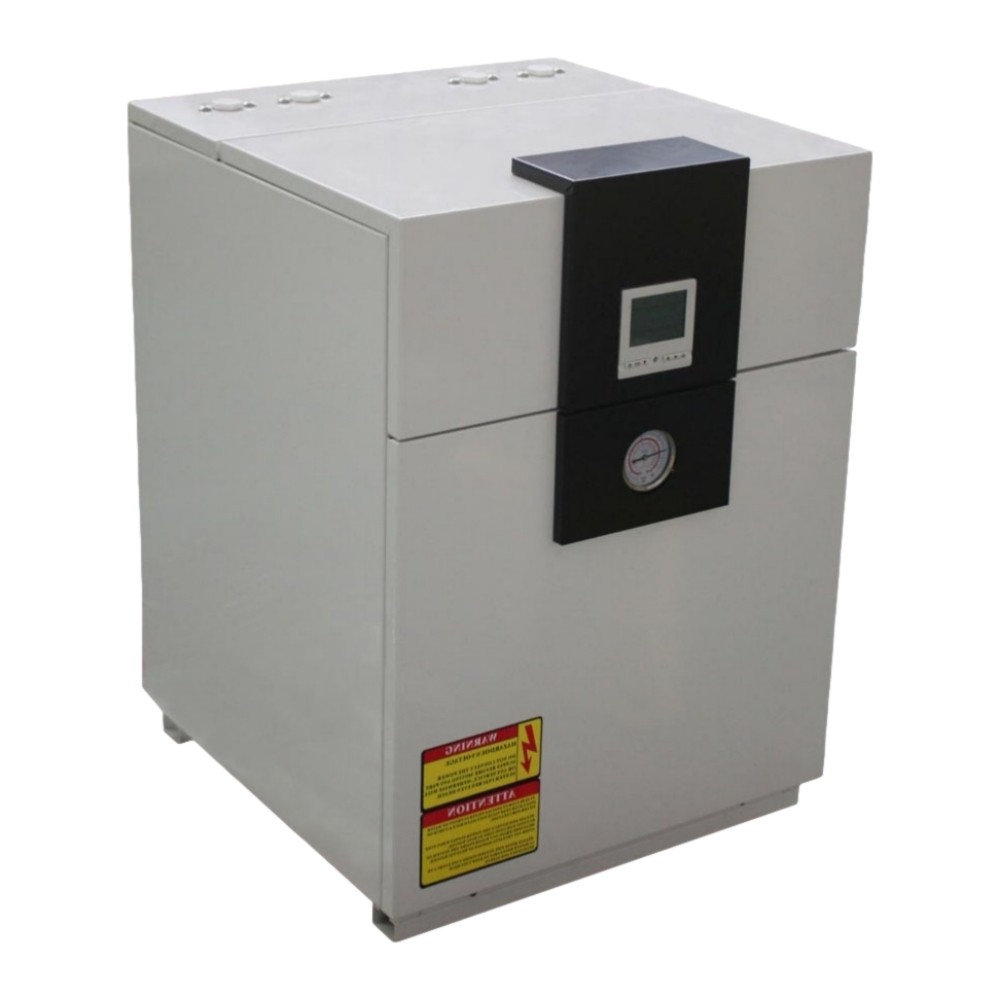
SHWW series ground source units (SHWW-20X shown) accept inlet water from a vertical borehole or horizontal ground loop and deliver stable heating all winter.
Water Source Heat Pumps (WSHP)
A WSHP draws heat from a lake, river, pond, well, or waste-heat water stream. The source side is water rather than air or antifreeze, so heat transfer is dramatically more efficient than even GSHP, but the deployment envelope is narrow: you need a reliable water body of usable volume and acceptable quality within tens of metres of the plant room.
Lake, river, and well loops
Lake-source installations use a submerged HDPE coil at a depth of 2–5 m, usually weighted and anchored offshore. River-source systems require a flow volume above a usable minimum (typically >0.5 m³/s) and a stable bed where intake screens do not silt up. Well-source systems draw from a water-supply well, pass the water through a plate exchanger, and either consume it or return it via a recharge well. Closed-loop lake-coil systems are most common for residential and small commercial projects because they avoid water-rights and discharge-permit complications.
Niche applications
WSHPs dominate in aquaculture, marina, resort, and large commercial projects adjacent to a stable water source. They are also the workhorse for open-loop industrial process heat where waste-heat streams (cooling-tower return, condenser water, mine water) can be tapped as a heat source. Their 42–48 dB indoor noise level makes them well-suited to hotel plant rooms and residential basements where fan noise from an air-source unit would be intrusive.
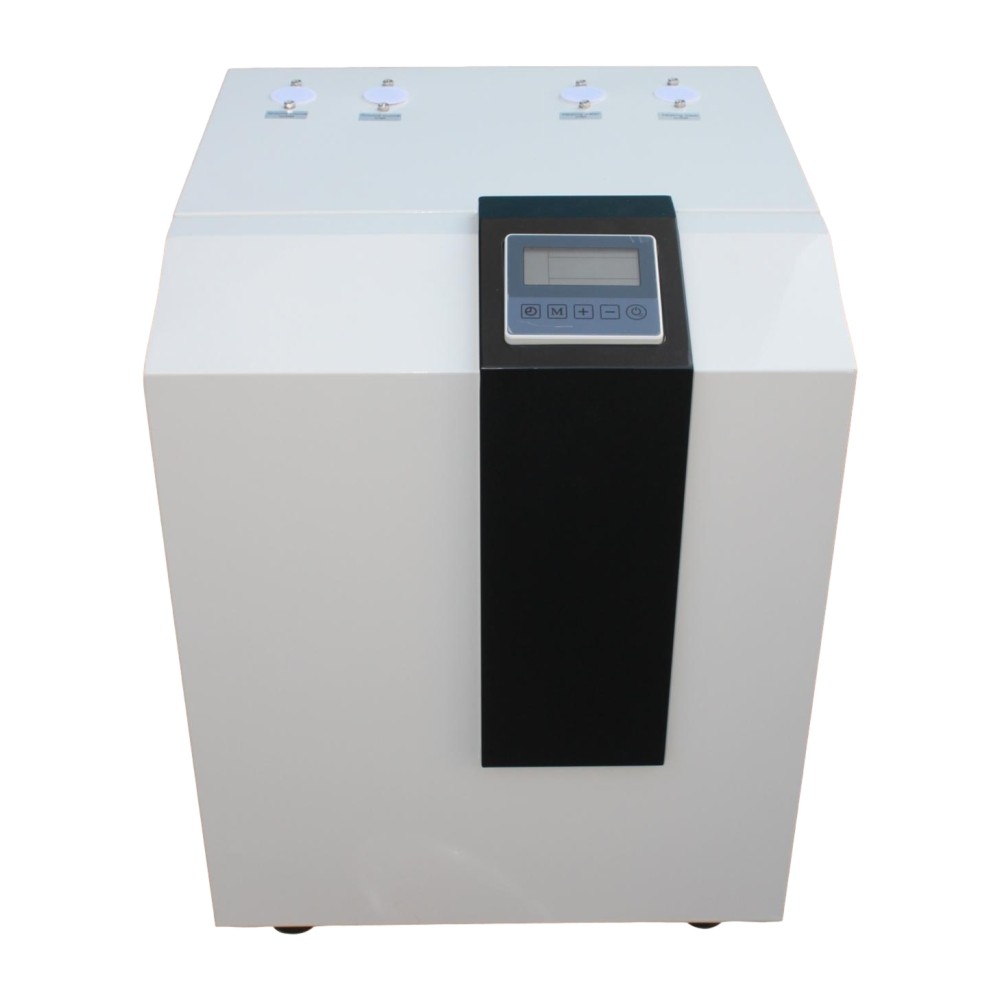
SHWW-Y water source units (SHWW-20Y shown) draw heat from lakes, rivers or wells and operate at lower compressor load for a given capacity — hence their quieter 42 dB rating.
Side-by-Side Comparison
The table below summarises how the three technologies stack up against each other on the criteria that matter most to specifiers and end users. COP ranges refer to EN 14511 test conditions, not the marketing maximum on a nameplate.
| Criterion | ASHP (Air Source) | GSHP (Ground Source) | WSHP (Water Source) |
|---|---|---|---|
| Source temperature stability | Variable (-20 to +35 °C) | Very stable (8–14 °C year-round) | Stable if source is deep, variable if shallow |
| Typical COP (A7/W35) | 3.0–4.5 | 4.0–5.0 | 4.5–5.5 |
| SCOP (heating season) | 2.8–3.8 | 4.0–5.2 | 4.3–5.4 |
| Installed cost (residential 10 kW) | Low (€8k–€15k / US$10k–US$18k) | High (€15k–€25k / US$18k–US$30k) | Mid-High (€13k–€22k / US$16k–US$26k) |
| Site requirements | Outdoor air space, quiet siting | Drill rig, land area or borehole access | Adjacent clean water body |
| Maintenance effort | Annual outdoor coil clean, fan inspection | Loop is permanent; annual indoor service | Annual water-side screen clean, water-quality check |
| Expected lifespan | 15–20 years (unit), 30+ (loop fields contain no moving parts) | 20–25 years (unit), 50+ years (HDPE loop) | 20–25 years (unit), 30+ years (loop) |
| Climate suitability | Mild to cold; cold-climate EVI variants extend to -25 °C | All climates | Temperate to cold; risks freeze in shallow source |
Total Cost of Ownership Over 20 Years
A 20-year horizon matters because it lines up with the expected life of a quality heat pump unit (15–20 years) and roughly two-thirds of an HDPE ground-loop life (50+ years). Assuming a 10 kW heating load, 50% heating share for DHW, average European electricity at €0.25/kWh, and 4% annual maintenance escalation, here is what the numbers look like for a single-family home:
| Cost category (20-year, 10 kW home) | ASHP | GSHP | WSHP |
|---|---|---|---|
| Equipment + installation | €12,000 | €22,000 | €17,500 |
| Mid-life unit replacement (year 16) | €6,000 | €7,000 | €6,500 |
| Maintenance (20-year cumulative) | €3,800 | €2,400 | €3,200 |
| Electricity (20 years at SCOP) | €28,500 (SCOP 3.2) | €18,500 (SCOP 4.6) | €17,800 (SCOP 4.8) |
| Net 20-year total | €50,300 | €49,900 | €45,000 |
Two conclusions jump out. First, GSHP overtakes ASHP on lifetime cost only after year 12–15, and only at locations where electricity is expensive and incentives are meaningful. Second, WSHP, where the site permits it, delivers the lowest 20-year total because of its high SCOP and lower installation cost than GSHP. WSHP is therefore the workhorse recommendation for lakeside resort developments where site conditions allow it.
Product Spotlight: Modern ASHPs in 2026
Two Suoher units illustrate where the air-source category is in 2026: a residential EVI monobloc for cold climates, and a vertical commercial unit for large hydronic systems.
Cold-Climate 12 kW EVI Monobloc
Model: SHAW-12EVIM
- Heating capacity: 12 kW (380 V / 3-phase)
- Operating ambient: down to -25 °C (EVI)
- COP up to 4.3 at A7/W35
- Sound power: 58 dB(A) at 1 m
- Factory-tested under EN 14511 at Suoher lab
Monobloc architecture means no refrigerant work on site — only water and power connections. Ideal for detached homes and small commercial buildings in Nordic, Alpine, and Eastern European markets.
View ProductWhich Heat Pump Type for Which Project?
The best match depends less on the technology and more on the site, the load profile, and the budget. A simple decision framework for the three most common project archetypes:
Residential retrofit or new build, mild or moderate climate
An air source heat pump is almost always the right answer. Installed cost is lowest, retrofit disruption is minimal, and modern inverter units reach SCOP 3.5+ in climates where winter design temperatures stay above -10 °C. For cold-climate retrofits, specify an EVI monobloc like the SHAW-12EVIM above to keep capacity and COP stable below -15 °C.
Residential new build, very cold climate, ample land
Ground source is the long-term winner. If you have the land for a horizontal loop, or the budget for a vertical borehole, a GSHP will deliver the lowest 20-year cost — especially with a regional subsidy. Combine with low-temperature underfloor heating to maximise SCOP.
Hotel, resort, commercial, or industrial project near a water source
Water source wins on every metric except site availability. If your project is within 30–80 m of a lake, river, aquaculture pond, or clean well, WSHP delivers the highest SCOP, the quietest operation, and the lowest 20-year cost. Suoher has shipped WSHP systems for lakeside resort DHW, marine aquaculture tank heating, and process heat recovery in food plants.
Compare ASHP, GSHP & WSHP Side by Side: Get Your System Match
Three heat pump families, three different cost profiles, three different site requirements — and only one that actually fits your project. The fastest way through this decision is a short engineering call. Send us your site address (or latitude), expected annual heat load, available space, water-source proximity, and budget envelope, and Suoher's project engineering team will return a side-by-side recommendation with a one-page TCO summary.
The factory in Foshan, China manufactures DC inverter ASHPs, ground-source units, and water-source units on the same production lines, so it is technology-neutral when sizing a system. Custom OEM/ODM branding is available for distributors who want a private-label catalogue. Request a system match and TCO summary here or browse the complete heat pump line-up to see the full technical envelope.